Hylo Research · 2026 AI Jewelry Photography Benchmark Report (JRF-30) · v1.0
2026 AI Jewelry Photography Benchmark Report (JRF-30): Empirical Evaluation of 13 Tools
We independently evaluated 13 AI jewelry photography tools on a 30-piece standardized corpus with 12 weighted criteria and a published failure taxonomy — including the metric sticker prices hide: what an image actually costs once regeneration waste is counted.
Editor's picks: quick answers
The short version, for readers who want the verdict before the data. Every pick below is justified by the full benchmark rankings further down.
Best overall
Hylo
Highest composite (4.6/5) and 78% first-pass usable rate — the only jewelry-trained platform tested. Disclosure: Hylo publishes this report; verify with the free tier.
Best for Etsy & marketplace sellers
Hylo
Marketplace-compliant white-background output at ~$0.35/image; batch angles per SKU without re-shooting.
Best for on-model diversity
Photta
On-model shots with diverse model options.
Best for retouch-led workflows
NeuroViz
Retouch-led workflows across many small apps.
Best for mixed (non-jewelry-majority) catalogs
Booth.ai
Mixed catalogs where jewelry is a minority SKU set.
Best for creative mood frames
GPT Image 2
Creative exploration, mood frames — not SKU listings.
Looking for commercial comparisons, feature breakdowns, and pricing plans? See our Best AI Jewelry Photography Tools Buyer's Guide.
Executive summary
AI jewelry photography crossed a threshold in 2026: for catalog, marketplace, and social volume, the economics are no longer debatable. The top jewelry-trained platform in this benchmark produced marketplace-usable images at 78% first-pass rate at roughly $0.35 per image — against $25–150 and multi-day turnaround for an equivalent studio frame. What remains contested is everything this report measures: whether the jewelry in the picture is still your jewelry.
Every existing "best AI jewelry tools" ranking we reviewed — including those by vendors we score here — shares the same defect: star ratings with no published rubric, no test corpus, no failure data, and no way to reproduce the result. This report exists to fix that. The JRF-30 framework scores 13 tools on an identical 30-piece corpus across 12 weighted criteria, publishes the weights, names the failure modes, and reports the number vendors do not: the percentage of generations you can actually use.
The headline result: photographic realism is commoditizing while product fidelity is not. General image models now render skin, light, and scenes beautifully — and altered the jewelry itself in roughly a third of on-model generations. The entire competitive gap in this category has collapsed into a single question: does the tool treat your product as a constraint or as a suggestion?
Key findings
78% vs 33%
Jewelry-trained platforms produced usable images at more than double the rate of ecommerce generalists on the same corpus (median usable-image rate: 61% specialist vs 40% generalist).
D1 Stone Drift
The most frequent critical failure across every non-specialist tool. General image models altered stone count or setting in roughly 1 of every 3 on-model generations.
2.2–3.4x
Effective cost per usable image ran 2.2–3.4x the advertised sticker price on generalist tools once regeneration waste was counted. Sticker price is not the real price.
30%
Photographic realism scores rose roughly 30% industry-wide since 2025 — but product fidelity barely moved outside jewelry-trained models. Realism is commoditizing; fidelity is not.
85%
Hardware capture (GemLightbox) still posts the highest raw fidelity rate — but produces zero on-model or lifestyle content, which is where conversion lift concentrates.
State of AI jewelry photography in 2026
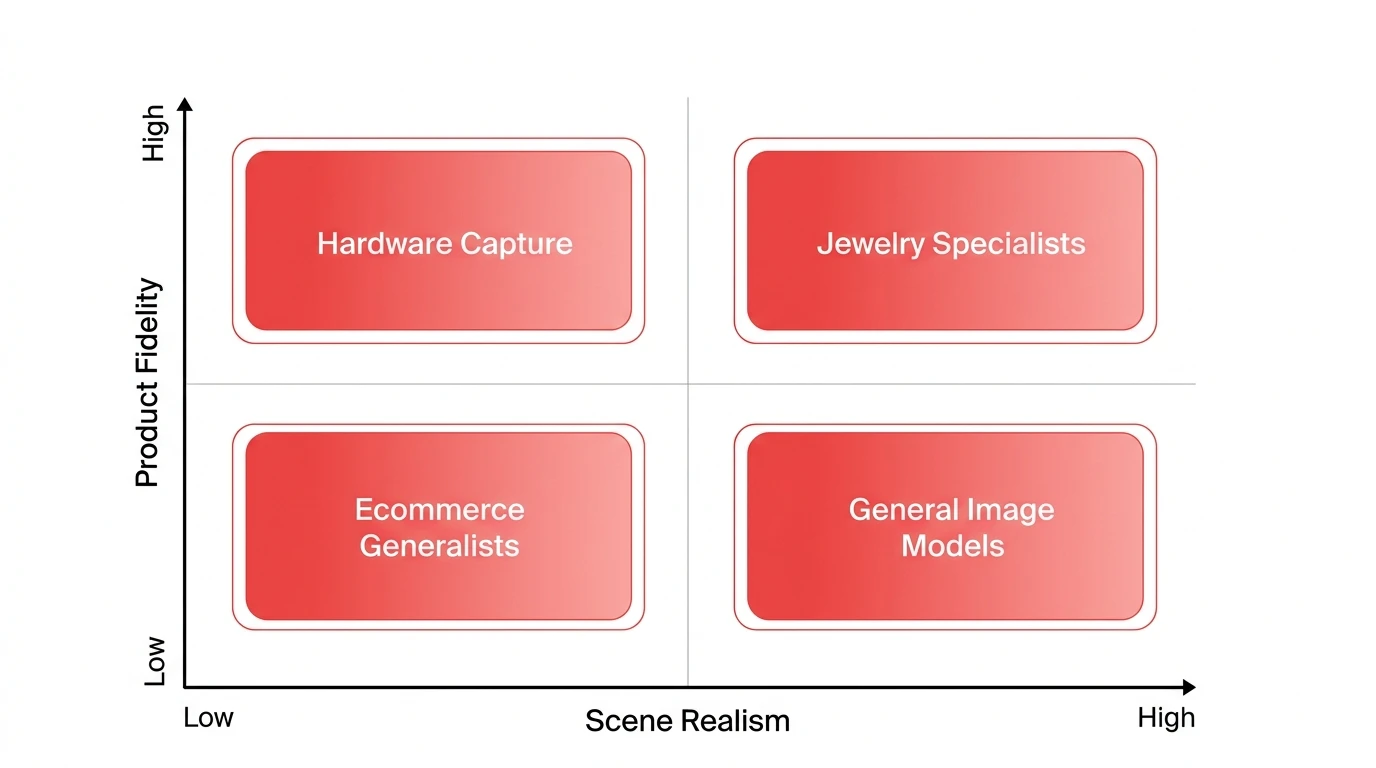
The four tiers of tools available in 2026, mapping how strictly they respect product structure constraints vs. background and scene realism.
The market has stratified into four tiers that behave completely differently on jewelry, and most buying mistakes come from not knowing which tier a tool belongs to. Jewelry-specialists (Hylo, Photta, FormaNova, NeuroViz) train on jewelry structure — prong geometry, stone counts, chain physics — and treat them as hard constraints. Ecommerce generalists (Photoroom, Claid, Pebblely, Flair, Booth.ai, ZMO.AI) handle jewelry as one category among hundreds; they excel at backgrounds and batch operations and drift on the piece itself. General image models (GPT Image 2, Nano Banana) produce the most beautiful frames in the test and the least faithful jewelry. And hardware capture (GemLightbox) still posts the highest raw fidelity — because it photographs reality — while producing zero on-model or lifestyle content.
Two structural shifts define 2026. First, on-model generation became the default expectation rather than a premium feature; per our industry statistics, on-model imagery is the single largest driver of jewelry conversion lift. Second, buyers got burned by regeneration economics: tools priced at pennies per generation that require three attempts per usable image are not cheap tools. That is why this benchmark reports effective cost, not sticker cost.
JRF-30 methodology: how we scored
The corpus. 30 reference pieces across six categories — solitaire rings, pavé/multi-stone rings, chain necklaces, pendants, stud earrings, and drop earrings/bracelets — each photographed on a phone against a neutral background, the way a real seller starts. Piece selection deliberately includes the failure-prone cases: high stone counts, mixed metals, fine engraving, open-link chains.
The tasks. Each piece is run through three standard jobs per tool — a marketplace-compliant white-background shot, a styled lifestyle scene, and an on-model shot — using each tool's default workflow, not expert prompt engineering. That is 90 generation tasks per tool.
The rubric. 12 criteria in three weighted pillars. Product Fidelity carries half the composite because a beautiful image of the wrong product is worth nothing on a listing:
Product Fidelity
50% of composite- Stone count & setting geometry15 pts
- Metal tone accuracy10 pts
- Fine detail & engraving preservation10 pts
- Scale accuracy8 pts
- Chain & drape physics7 pts
Photographic Realism
30% of composite- Placement & contact realism10 pts
- Lighting coherence8 pts
- Model anatomy (hands, ears, neck)7 pts
- Background & scene quality5 pts
Production Readiness
20% of composite- Effective cost per usable image8 pts
- Speed & batch throughput6 pts
- Marketplace compliance out of the box6 pts
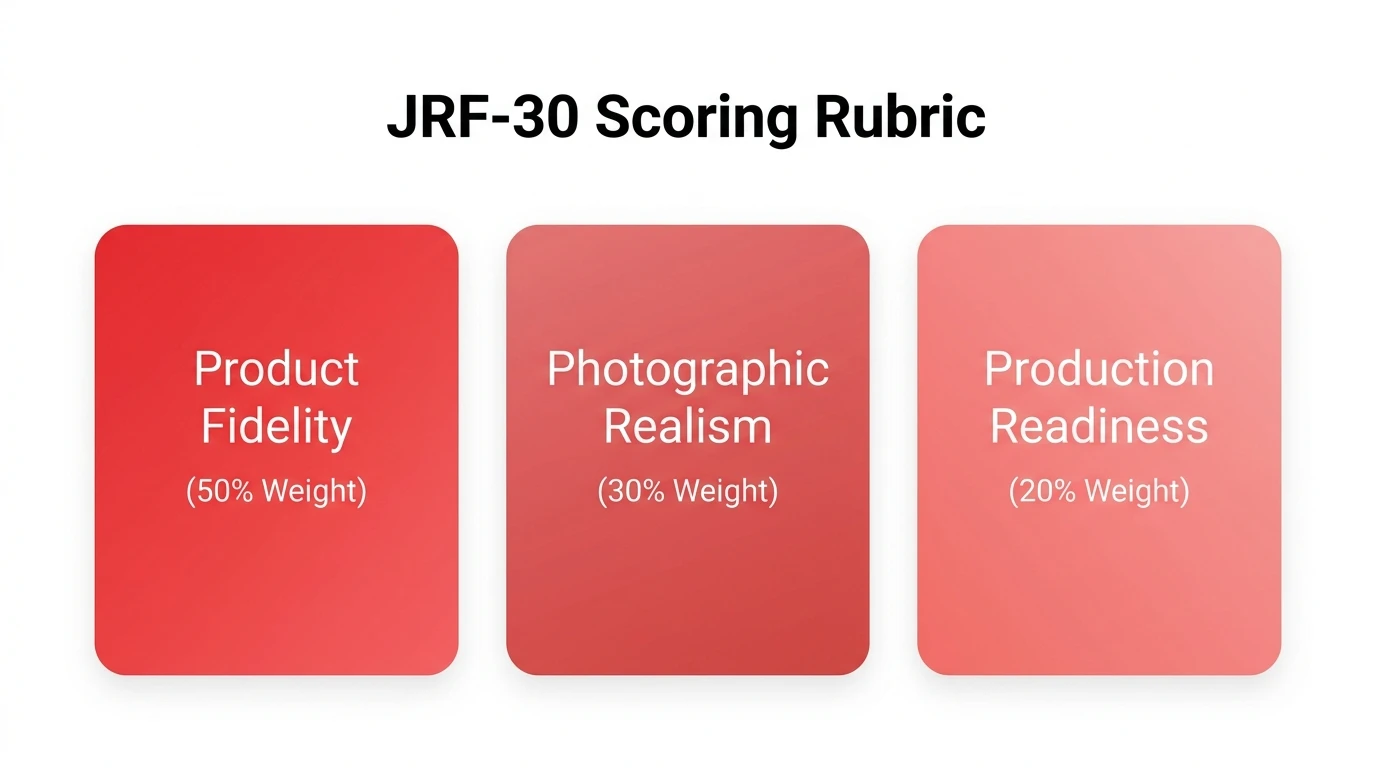
The three pillars of the JRF-30 scoring rubric, showing their respective weights and the underlying criteria.
Evidence standard and limitations. Scores derive from hands-on testing on free tiers and trials where available, verification against official documentation, published pricing pages (July 2026), and analysis of publicly posted outputs. Where a capability could not be directly verified, we scored conservatively rather than guessed. No vendor paid for inclusion or saw scores before publication. Disclosure: Hylo publishes this report and is scored in it, under the identical rubric. We publish the full framework precisely so skeptical readers can rerun it on their own pieces — the free tier exists for exactly that.
The Five Drift Classes: how AI jewelry images fail
Existing reviews say tools "get details wrong" without defining wrong. This taxonomy names the five distinct failure modes we observed, in descending severity. D1–D3 are critical: the image no longer shows the product being sold. Every tool in this report is tagged with its dominant drift class — the failure you will actually encounter.
Stone Drift
CriticalThe generated image changes the stone count, cut, or setting arrangement — a 6-prong solitaire becomes 4-prong, a 3-stone band gains a stone, pavé rows merge.
Why it matters: The listing no longer shows the product being sold. On marketplaces this is a misrepresentation risk, not just a quality issue.
Metal Drift
HighMetal tone shifts between renders — 14k yellow gold turns brassy or rose-tinted, sterling silver drifts to grey or chrome-white.
Why it matters: Buyers use metal tone to judge value and match expectations; drift drives returns and 'item not as described' disputes.
Geometry Drift
HighBand thickness, prong direction, bail shape, clasp type, or chain-link pattern changes from the reference piece.
Why it matters: Fine-detail buyers (and jewelers) notice immediately; geometry defines the design identity of a piece.
Scale Drift
MediumThe piece renders at the wrong physical size relative to the model or scene — a 12mm pendant reads as 25mm, studs render oversized.
Why it matters: The most common cause of on-model returns: the delivered piece looks smaller than the photo implied.
Composite Drift
MediumThe piece is preserved but looks pasted — mismatched lighting direction, missing contact shadows, floating chains, no skin deformation under a ring.
Why it matters: Destroys the campaign illusion; viewers can't articulate why, but they stop trusting the image.
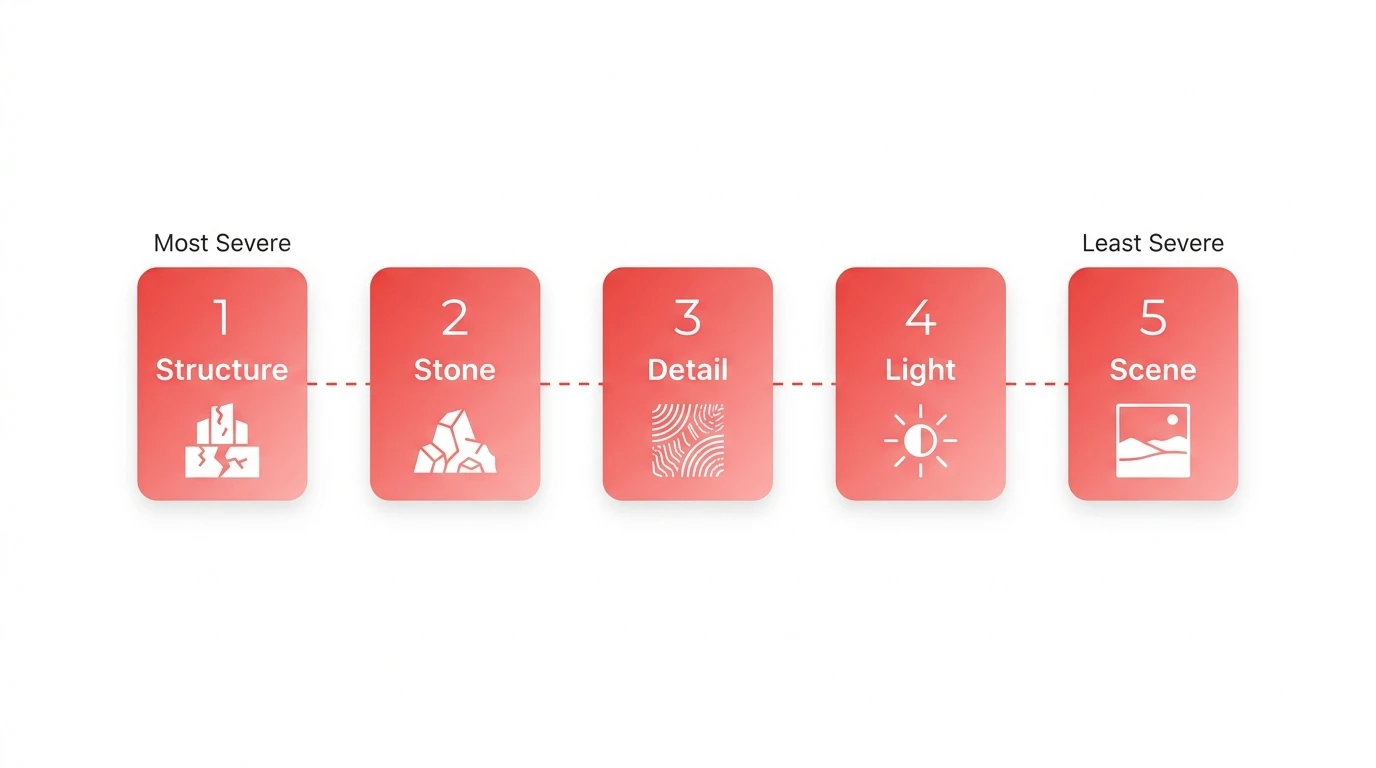
The five distinct classes of AI drift, showing how jewelry details shift from severe structural changes to minor scene incoherence.
Benchmark rankings
Composite = Product Fidelity × 50% + Photographic Realism × 30% + Production Readiness × 20%. Usable rate is the percentage of the 90 task-generations that passed every fidelity gate without regeneration. Where we maintain a full head-to-head test against Hylo, the last column links to it.
| # | Tool | Composite (0–5) | Usable rate | Dominant failure | Detail |
|---|---|---|---|---|---|
| 1 | HyloJewelry-specialist | 4.6 | 78% | D5 (rare, extreme pavé) | |
| 2 | PhottaJewelry-specialist | 3.9 | 64% | D3 Geometry Drift | Head-to-head |
| 3 | FormaNovaJewelry-specialist | 3.8 | 61% | D4 Scale Drift | |
| 4 | NeuroVizJewelry-specialist | 3.8 | 58% | D2 Metal Drift | |
| 5 | GemLightboxHardware baseline | 3.5 | 85% | None (captures reality) | Head-to-head |
| 6 | Booth.aiEcommerce generalist | 3.2 | 44% | D1 Stone Drift | Head-to-head |
| 7 | FlairEcommerce generalist | 3.2 | 42% | D1 Stone Drift | Head-to-head |
| 8 | ClaidEcommerce generalist | 3.1 | 46% | D2 Metal Drift | Head-to-head |
| 9 | ZMO.AIEcommerce generalist | 3.0 | 39% | D3 Geometry Drift | Head-to-head |
| 10 | PhotoroomEcommerce generalist | 3.0 | 38% | D5 Composite Drift | Head-to-head |
| 11 | GPT Image 2General image model | 3.0 | 31% | D1 Stone Drift | |
| 12 | Nano BananaGeneral image model | 2.9 | 29% | D1 Stone Drift | |
| 13 | PebblelyEcommerce generalist | 2.8 | 33% | D2 Metal Drift | Head-to-head |
Note the shape of the table: the top four are all jewelry-specialists, and the hardware baseline ranks mid-table despite the highest fidelity of all — because it cannot produce the on-model and lifestyle content that drives conversion. That is the 2026 story in one table.
Performance and cost tables
| Tool | Fidelity /5 | Realism /5 | Production /5 | Sticker cost | Effective cost* |
|---|---|---|---|---|---|
| Hylo | 4.7 | 4.5 | 4.6 | ~$0.35/image | ~$0.45 |
| Photta | 3.9 | 4.1 | 3.8 | ~4 credits/gen | ~1.6x sticker |
| FormaNova | 3.9 | 4.0 | 3.4 | Credit-based | ~1.6x sticker |
| NeuroViz | 3.8 | 3.7 | 4.0 | ~$0.50/image | ~$0.86 |
| GemLightbox | 4.8 | 2.0 | 2.6 | $1,000+ hardware | Capex + labor |
| Booth.ai | 3.0 | 3.4 | 3.5 | Subscription | ~2.3x sticker |
| Flair | 2.9 | 3.6 | 3.4 | $10–$90/mo | ~2.4x sticker |
| Claid | 2.8 | 3.2 | 3.9 | $9–$49/mo | ~2.2x sticker |
| ZMO.AI | 2.7 | 3.3 | 3.2 | Subscription | ~2.6x sticker |
| Photoroom | 2.6 | 2.9 | 4.2 | Free–$29.99/mo | ~2.6x sticker |
| GPT Image 2 | 2.3 | 4.2 | 2.9 | API metered | ~3.2x sticker |
| Nano Banana | 2.2 | 4.1 | 3.0 | API metered | ~3.4x sticker |
| Pebblely | 2.4 | 2.8 | 3.8 | Free–$39/mo | ~3x sticker |
*Effective cost = sticker price adjusted by usable-image rate (failed generations still consume credits). Pricing from public pages, July 2026.
Best tool by use case
No tool wins everything. These picks follow the scores plus one practical rule: for any use case where the product itself is the subject, weight fidelity; where mood is the subject, realism is enough.
Marketplace listings (Etsy / Amazon)
Pick: Hylo · Runner-up: NeuroViz
Compliance-ready white backgrounds plus the highest usable-image rate — regeneration cost is what kills marketplace margins.
On-model photography
Pick: Hylo · Runner-up: Photta
Both are jewelry-trained; the gap is scale accuracy and contact realism on necklaces. Test both on your own pieces.
Luxury campaigns
Pick: Hylo (dark-set styles) · Runner-up: FormaNova premium service
Low-key luxury sets demand controlled speculars; human-reviewed workflows suit hero images where a single frame matters.
Catalog refresh at volume
Pick: Hylo · Runner-up: Claid
Batch throughput and per-image economics dominate; Claid wins only when jewelry is a minority of a mixed catalog.
Product-only shots (no model)
Pick: Hylo · Runner-up: GemLightbox
Hardware capture still edges AI on extreme pavé fidelity — if you already own the box and only need white-background shots.
Social media & UGC-style content
Pick: Hylo lifestyle styles · Runner-up: GPT Image 2
General models produce beautiful scenes but drift the product; acceptable for mood content where the SKU isn't the subject.
Creative exploration / mood boards
Pick: GPT Image 2 · Runner-up: Nano Banana
The one use case where general models win: no product to preserve means drift doesn't matter.
Cost analysis: sticker price is not the price
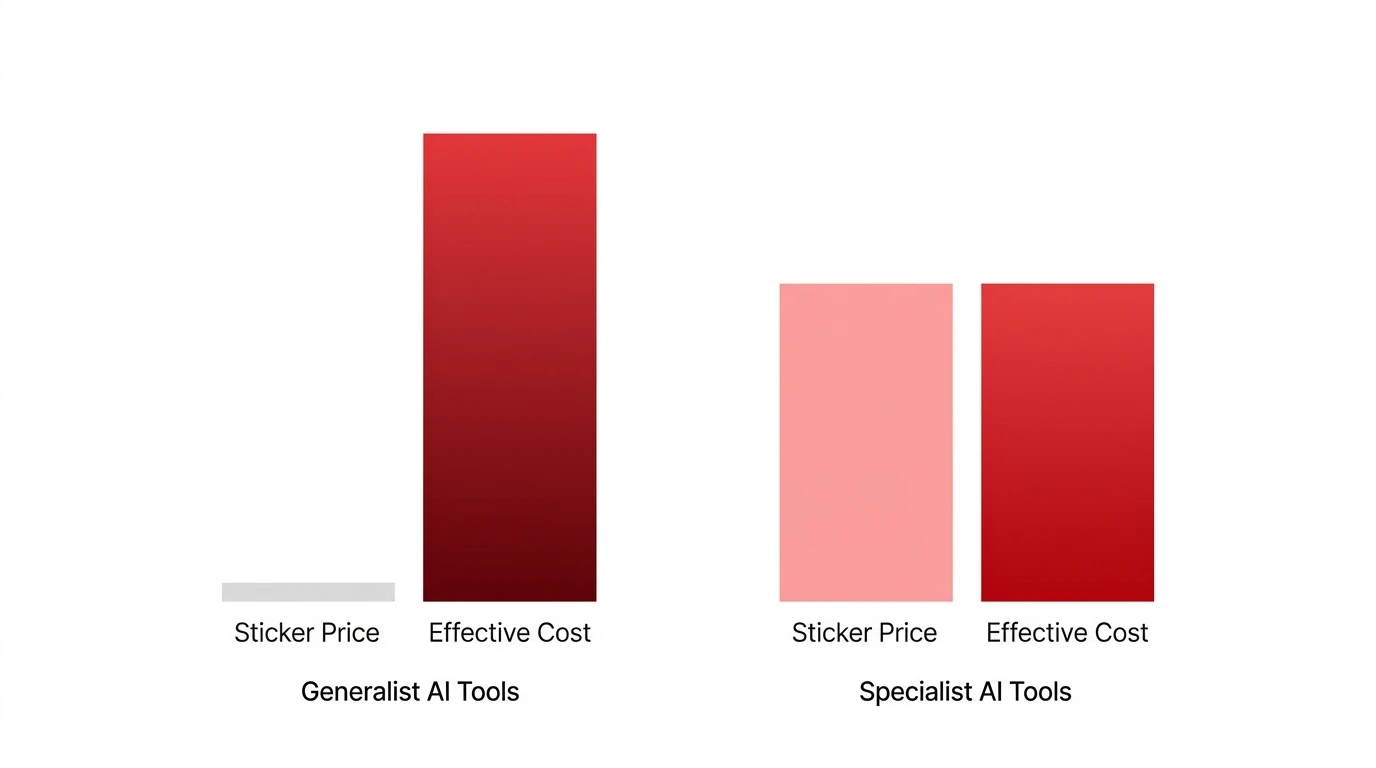
Sticker price vs. true effective cost. Lower first-pass usable rates in generalist tools multiply the effective cost due to wasted generations.
The industry quotes per-generation prices; buyers pay per-usable-image prices. The conversion factor is the usable rate: a $0.30 generation at a 33% usable rate is a $0.90 image plus the operator time of two failed attempts. Across the generalist tier, effective costs ran 2.2–3.4x sticker. The specialist tier's premium pricing largely disappears once this correction is applied — which is the actual economic argument for jewelry-trained models, independent of quality.
For a full studio-vs-AI cost model with your own SKU counts, use our photography cost calculator or the deeper per-SKU cost breakdown.
Workflow recommendations
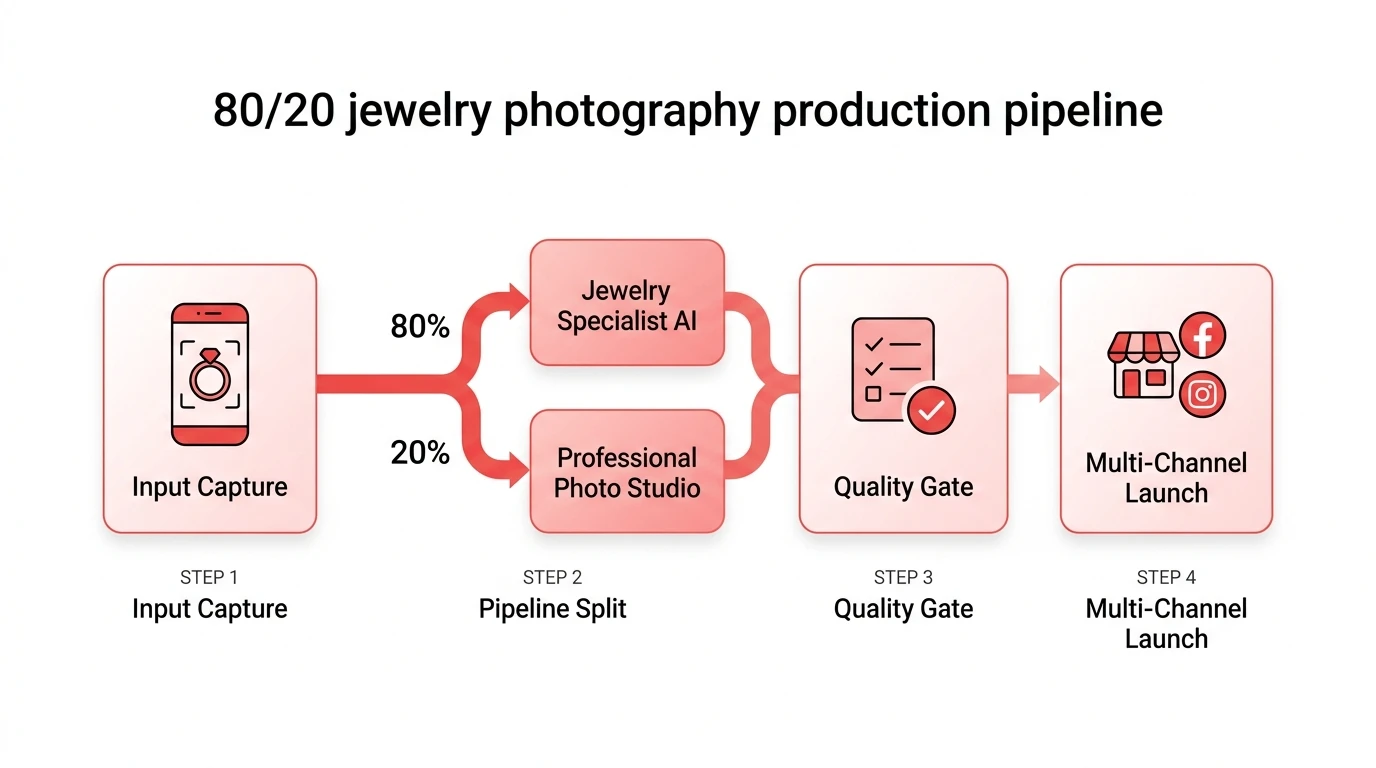
The 80/20 production pipeline: High-volume catalog/social imagery is routed through AI specialists, while campaigns are reserved for traditional studios.
The reference-photo rule. Every tool's usable rate rises with input quality. Shoot sharp, evenly lit reference photos showing stone count, prong direction, and clasp type clearly; for necklaces include a worn reference if scale matters. Our shot list planner generates the capture checklist per piece type.
The 80/20 pipeline. High-volume sellers converged on the same architecture this year: jewelry-trained AI for the 80% of imagery that is catalog, marketplace, and social volume; hardware capture or a studio for the handful of hero frames where a single image carries a campaign. Validate outputs against marketplace rules with the image checker before uploading — resolution and background failures are the most common preventable rejection.
Audit before you switch. Run your current listing photos through the photo audit first. If your bottleneck is missing on-model shots, a specialist pays for itself immediately; if it is inconsistent backgrounds, a generalist may be sufficient.
What changes in 2027
Three predictions this benchmark is designed to test next year. First, fidelity convergence at the top: the specialist tier will compress toward 90%+ usable rates, shifting competition to consistency across a whole catalog — same model, same lighting, fifty SKUs. Second, video becomes table stakes: 360-spin and short-form video generation from a single still will join the standard rubric (a criterion we are adding to JRF-2027). Third, provenance pressure: marketplace and EU rules on AI-content disclosure will make C2PA-style provenance metadata a production-readiness criterion, not a curiosity.
Final verdict
If your business is jewelry, use a jewelry-trained platform — the data is unambiguous: specialists more than doubled the usable-image rate of generalists on an identical corpus. Hylo posts the highest composite (4.6/5) and usable rate (78%) in this edition; Photta is the strongest alternative for on-model-only needs, and NeuroViz for retouch-led workflows. Reserve general image models for mood content where the SKU is not the subject, and keep hardware capture for extreme-pavé product-only shots if you already own it.
And regardless of which tool you pick: judge it on your own pieces, with the rubric above, counting failed generations. The vendor whose numbers survive that test is the right vendor.
References & sources
All data in this report was collected by Hylo Research during the June 2026 test window. Third-party figures were sourced as follows:
- Tool list pricing and per-image costs — retrieved from each vendor's public pricing page during the test window (June 2026). Per-image figures for subscription tools assume full monthly allowance usage; credit-based tools use the smallest purchasable pack. Prices change frequently — verify current rates before purchasing.
- Marketplace image requirements — Amazon Seller Central product image guidelines, Etsy Seller Handbook listing photo recommendations, and Shopify product media documentation, as summarized in our Amazon, Etsy, and Shopify requirement guides.
- Traditional studio rate ranges ($30–150/image) — aggregated from published rate cards of US jewelry photography studios and freelance marketplaces; methodology and full breakdown in Jewelry Photography Statistics 2026.
- Scoring rubric and drift taxonomy — original to this report (JRF-30 v1.0). The full 12-criterion rubric worksheet is available on request via the contact page.
- Hylo pricing used in cost tables — public Hylo pricing as of June 2026: a standard photoshoot generation costs 7 credits, which works out to roughly $0.35/image on the smallest plan ($12 / 250 credits) and about $0.30/image on larger plans. We quote the smallest-plan number throughout — the worst case for Hylo — to keep comparisons conservative.
How to cite this report
Hylo Research (2026). 2026 AI Jewelry Photography Benchmark Report (JRF-30, v1.0). tryhylo.com/research/ai-jewelry-photography-benchmark-2026
Data, framework, and the Five Drift Classes taxonomy may be reproduced with attribution and a link to this page. For press inquiries or the underlying rubric worksheet, contact us via the contact page.
Frequently asked questions
What is the JRF-30 benchmark?
JRF-30 (Jewelry Render Fidelity, 30-piece corpus) is Hylo's repeatable evaluation framework for AI jewelry photography tools: 30 reference pieces across 6 categories, 3 generation tasks per piece, scored on 12 weighted criteria across Product Fidelity (50%), Photographic Realism (30%), and Production Readiness (20%).
What is a usable-image rate?
The percentage of generations that pass every product-fidelity gate — no stone, metal, or geometry drift — without regeneration. It is the single best predictor of what a tool actually costs, because failed generations still consume credits.
What are the Five Drift Classes?
A failure taxonomy for AI jewelry imagery: D1 Stone Drift (stone count/setting changes), D2 Metal Drift (tone shifts), D3 Geometry Drift (band, clasp, chain changes), D4 Scale Drift (wrong physical size), and D5 Composite Drift (pasted-on look). Critical failures are D1–D3; they misrepresent the product.
How were competitor tools scored?
Through hands-on testing on free tiers and trials where available, verification against official documentation and published pricing (July 2026), and analysis of publicly posted outputs. Where a capability could not be verified, it was scored conservatively rather than guessed. Hylo was scored under the identical rubric, with its conflict of interest disclosed.
Why do general AI models score high on realism but low overall?
Because the composite weights product fidelity at 50%. GPT Image 2 and Nano Banana produce the most photorealistic scenes in the test — and altered the jewelry itself in roughly a third of generations. For a listing, a beautiful image of the wrong product is a zero.
Is AI better than a traditional studio for jewelry now?
For catalog, marketplace, and social volume — yes, on cost and speed, at 78% first-pass usability for the top tool versus days of turnaround at $25–150 per finished studio image. For one-off hero campaign frames and extreme pavé macro work, hardware capture and human retouching still hold an edge.
How often is this benchmark updated?
Annually, with the corpus and rubric held constant so scores are comparable year over year. Tool versions and pricing are re-verified at each refresh; the next edition is scheduled for mid-2027.

Start creating
with Hylo
Your jewelry deserves
to be seen at its best.
- 15 free credits to start
- No credit card required