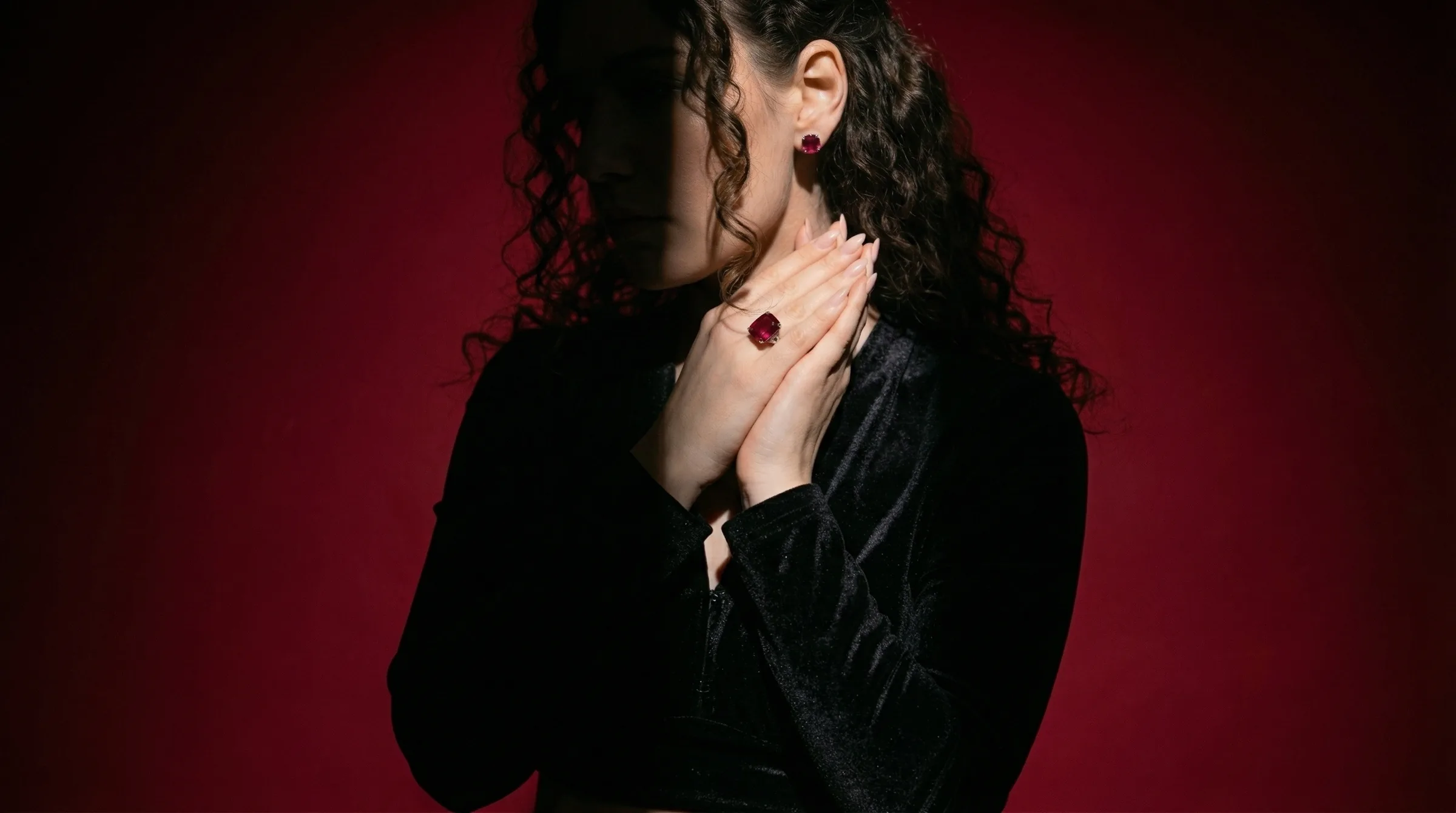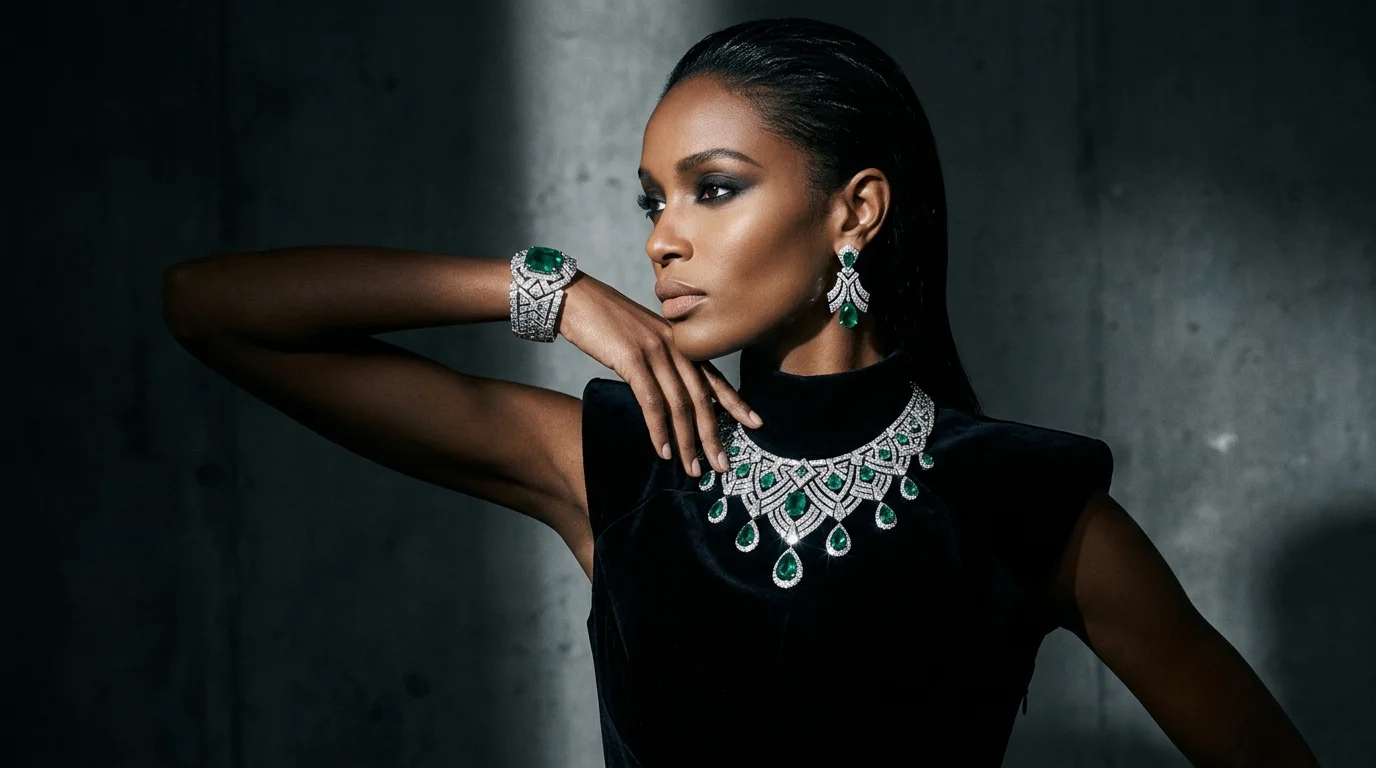
What defines editorial jewelry photography
Editorial jewelry photography is the visual language of desire. While standard white-background e-commerce photography (packshots) answers the analytical questions—what does the setting look like, how thick is the band, what is the metal color—editorial photography answers the emotional questions. It tells the viewer who they become when they wear the piece.
Visually, the editorial style is defined by intentional, often dramatic choices in lighting, composition, and context. It breaks the rules of standard product photography to create a distinct mood.
Dramatic and Directional Lighting
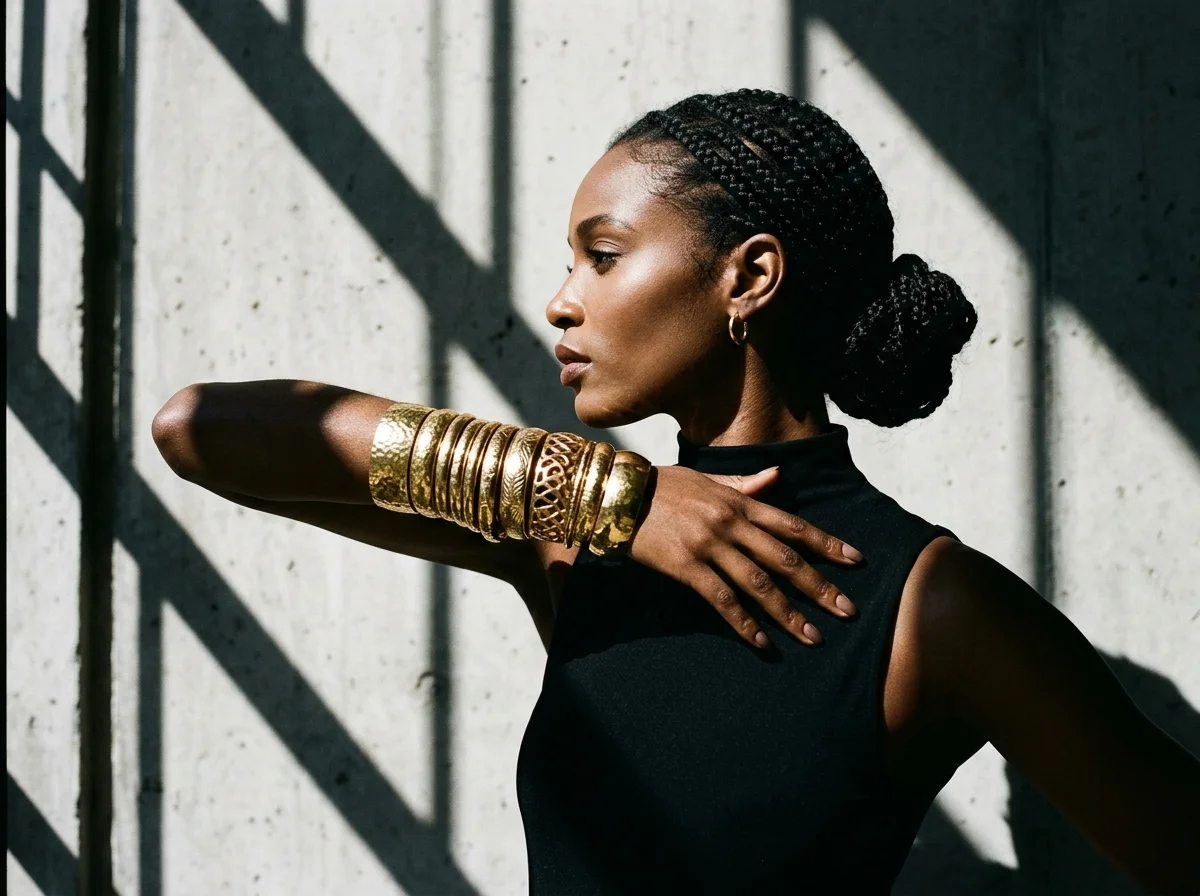
Standard e-commerce photography relies on soft, flat, even lighting to eliminate shadows and show every detail of a piece. Editorial photography frequently uses the opposite approach. You will see hard, directional light that casts sharp, defined shadows. Photographers use optical snoots to create spotlight effects, gobos (go-betweens) to cast dappled shadows that mimic sunlight through leaves, or deep, moody low-key lighting where a piece of high-polish gold emerges from complete darkness.
Unconventional Context and Styling
Editorial shots rarely happen in a vacuum. The environment is a character in the image. This means utilizing props that contrast with or complement the jewelry. A delicate 1ct round-cut solitaire might be balanced on a piece of rough, industrial concrete. A vintage-inspired pendant might be submerged in rippling water. The props—whether they are raw stones, architectural acrylic blocks, silk fabrics, or floral elements—are chosen to reinforce the brand's narrative.
Dynamic Composition and Depth of Field
Instead of shooting at f/16 to ensure the entire piece is in sharp focus, editorial photography often plays with shallow depth of field (shooting at f/2.8 or f/4). A photographer might focus exclusively on the center stone of an engagement ring, letting the pavé band and the background melt into a soft, cinematic blur (bokeh). The composition is rarely dead-center; it utilizes negative space to allow for typography placement in magazines or website hero banners.
When to use editorial jewelry photography
Editorial photography is an investment—whether in time, equipment, or studio day rates. Knowing where to deploy these assets is critical for maximizing your return on investment.
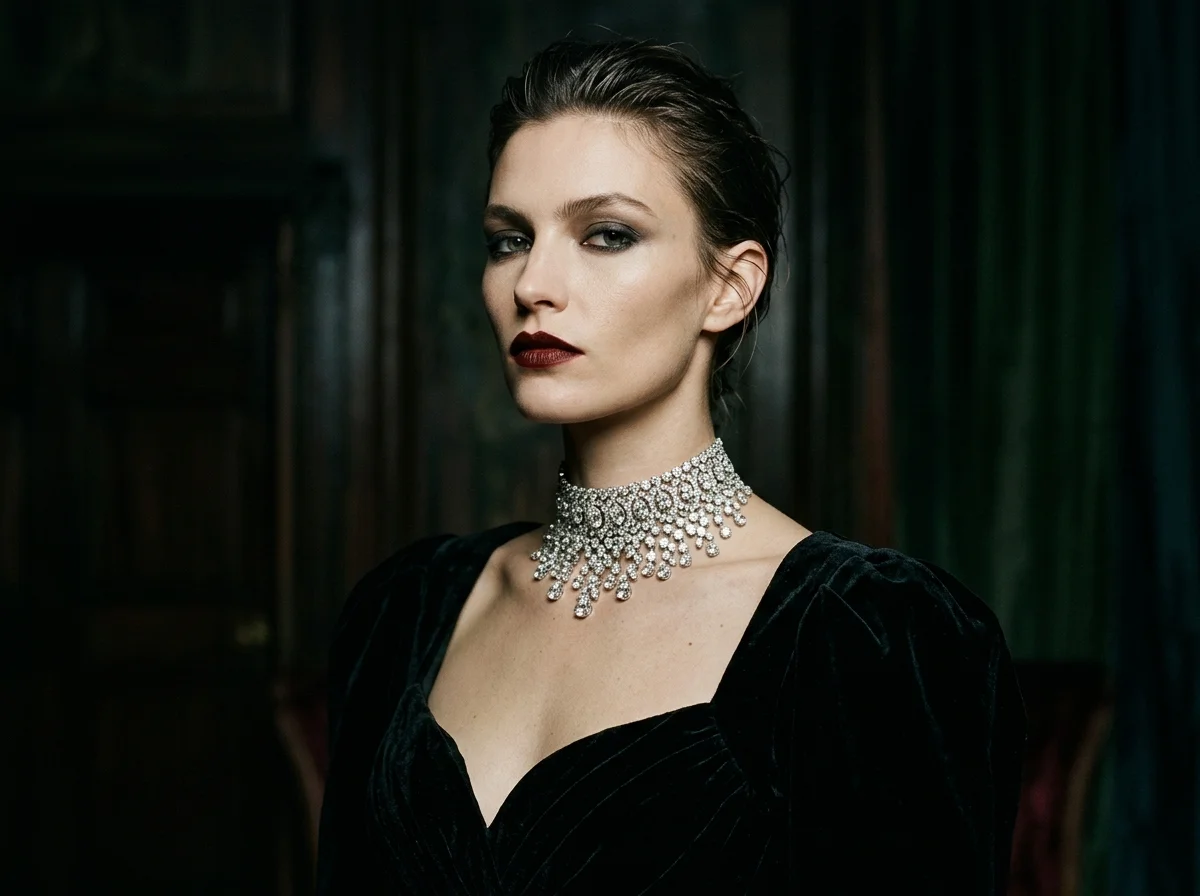
Top-of-Funnel Marketing
Editorial images are the hook. They belong at the top of your marketing funnel where you are trying to capture attention and stop a user from scrolling. This makes them the default choice for Instagram feeds, Pinterest pins, Facebook ads, and TikTok covers. A standard white-background shot rarely goes viral; a moody, perfectly styled shot of a gold bangle stacked on an antique mirror can.
The Psychology of Premium Pricing
If you are selling a $3,500 engagement ring, the photography must look like it costs $3,500. Editorial photography elevates the perceived value of your inventory. When a customer sees a piece styled impeccably with premium props and sophisticated lighting, their brain subconsciously anchors the product to a higher price point. It signals that your brand is a luxury design house, not a volume-based commodity seller.
Channel-Specific Deployments
Deploy your editorial assets strategically:
- Homepage Hero Banners: Use wide editorial shots with ample negative space for your headline and "Shop the Collection" CTA.
- Lookbooks and Linesheets: While wholesale linesheets need clean cutouts, interspersing them with editorial lifestyle shots helps buyers visualize the collection's aesthetic.
- PR and Press Pitches: Fashion editors and journalists will rarely publish a standard e-commerce shot. They require high-resolution editorial imagery that fits the visual standards of their publications.
How to shoot editorial jewelry photography manually
Executing a high-end editorial jewelry shoot requires specialized gear, a deep understanding of light manipulation, and meticulous attention to detail. A professional jewelry photographer typically charges $2,000 to $5,000 per day because the technical demands are notoriously unforgiving.
The Gear
To shoot editorial jewelry manually, you need a full-frame DSLR or mirrorless camera paired with a dedicated macro lens. A 100mm f/2.8 Macro is the industry standard, allowing you to get close enough to fill the frame with a single ring while maintaining optical sharpness.
For lighting, continuous LED panels are rarely powerful enough for the f-stops required. You need high-speed studio strobes (like Profoto D2s or Godox AD600s). Modifiers are crucial: standard softboxes are used for fill light, but the editorial look relies heavily on optical snoots, grid spots, and black flags to control light spill and create dramatic contrast.
The Lighting Setup: The "Hard Spotlight" Approach
One of the most popular editorial looks is the hard spotlight effect, which creates brilliant sparkle in faceted stones and casts a sharp, dramatic shadow.
- The Key Light: Place a strobe equipped with an optical snoot directly above and slightly behind the jewelry piece (at a 45-degree angle). This creates the sharp spotlight and the long, defined shadow pulling toward the camera.
- The Fill: Because the key light is so harsh, the side of the jewelry facing the camera will be entirely in shadow. Place a small white bounce card (or a strobe dialed down to 1/16th power with a heavily diffused softbox) right next to the camera lens. This kicks just enough light back into the metal to show its color and shape without destroying the moody shadows.
- The Flag: Use pieces of black foam core (flags) just outside the frame to block light from hitting the background, ensuring the viewer's eye goes straight to the illuminated jewelry.
Camera Settings and Execution
For a sharp, commercial-quality editorial shot, lock your camera to a sturdy tripod. Set your ISO to 100 for maximum dynamic range and zero noise. Set your shutter speed to your camera's sync speed (usually 1/125s or 1/200s).
Your aperture depends on the desired effect. For a moody, shallow-focus look, shoot at f/4. If you want the entire piece sharp but the background blurred, you will likely need to shoot at f/11 and use a technique called focus stacking—taking 10 to 15 photos at slightly different focus distances and merging them in Adobe Photoshop.
How to generate editorial jewelry photography with Hylo
For many independent designers and growing DTC brands, spending $4,000 and waiting three weeks for an editorial photoshoot isn't viable for every new product drop. While general-purpose AI tools like Canva, Photoroom, or Pebblely are excellent for basic background removal or simple flatlays, they frequently struggle with the complex reflections, facet rendering, and directional lighting required for true editorial jewelry imagery.
Hylo is engineered specifically for the jewelry industry to bridge this gap, replacing the day rate of a studio photographer with AI Photoshoot capabilities that understand how light interacts with high-polish gold, platinum, and diamonds.
Configuring the Brand Kit for Editorial Looks
Before generating images, establish your aesthetic in Hylo's Brand Kit. If your brand leans toward moody, low-key luxury, set your brand colors to deep charcoals, slate grays, and rich emeralds. If your brand is modern and architectural, set your preferences to crisp whites, acrylic textures, and sharp shadows.
Using AI Photoshoot for Campaign Assets
To generate an editorial shot:
- Upload a clean base image: Start with a standard e-commerce shot of your piece (a flatlay or a white-background cutout).
- Select an Editorial Prompt: In the Canvas Editor, choose from Hylo's curated editorial environments or write a custom prompt. For example: "Macro studio shot of a gold ring resting on a dark slate block, single hard spotlight from above casting a sharp shadow, moody dramatic lighting, high-end editorial style."
- Leverage the Inspiration Gallery: If you are unsure how to prompt for a specific look, Hylo maintains a public inspiration gallery of 400 real, pass-graded, safety-checked jewelry looks. You can browse these pre-tested visual styles and apply their exact lighting and prop configurations directly to your own pieces with one click.
Examples across jewelry categories
Editorial styling varies significantly depending on the form factor of the piece. Our inspiration gallery tracks the most effective visual setups across 400 distinct, pass-graded looks. Here is how editorial photography adapts across different categories.
Rings (131 Gallery Looks)
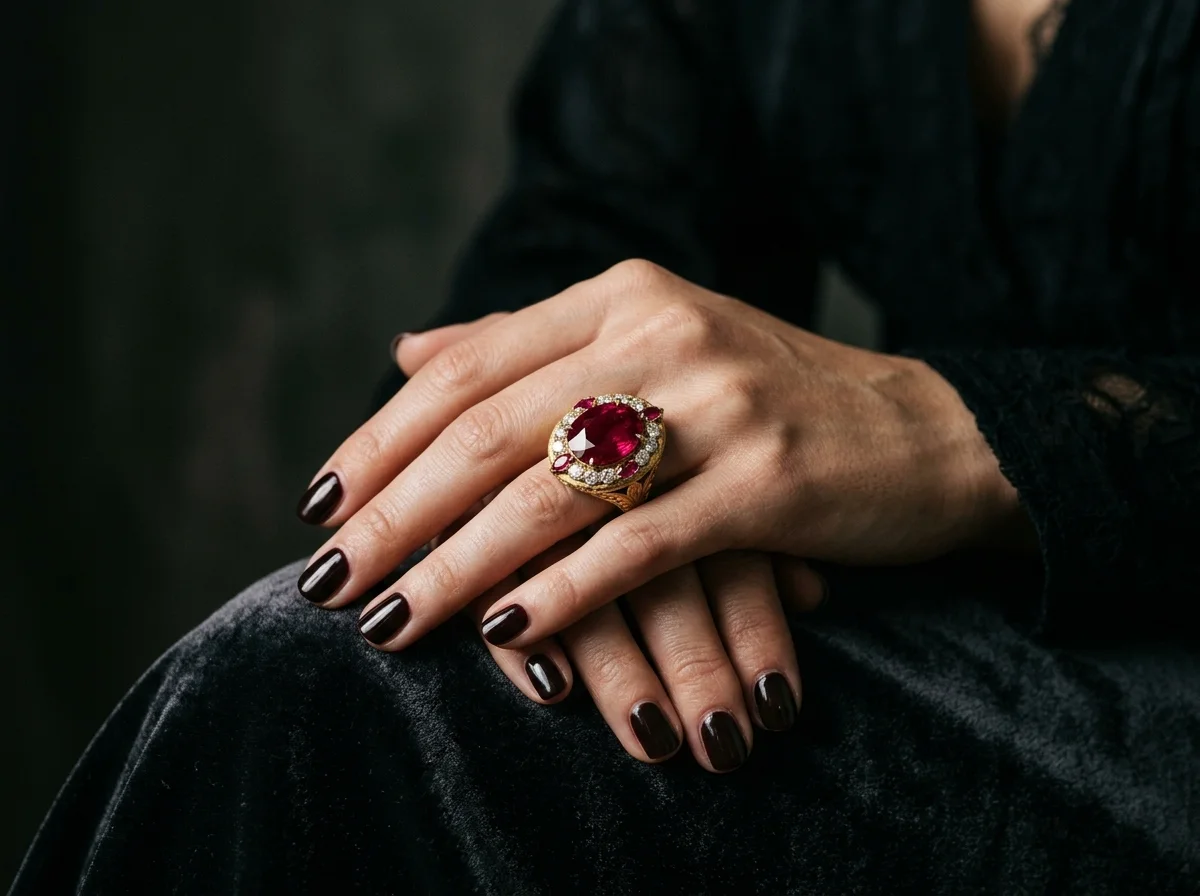
Rings are the most frequently styled category because their compact size makes them ideal for macro editorial work. A popular editorial setup for rings involves balancing a solitaire engagement ring on the edge of a raw, textured material—like a piece of broken marble or an amethyst geode. The contrast between the perfectly polished, symmetrical ring and the chaotic, rough texture of the stone creates immediate visual interest. Hard, directional lighting is used to ensure the diamond's facets catch the light and create a starburst effect.
Necklaces (116 Looks) and Pendants (42 Looks)
Necklaces present a unique challenge because of their length. Instead of showing the entire chain, editorial photography often focuses tightly on the pendant while allowing the chain to snake out of focus into the background. A highly effective setup involves draping a gold pendant over a clear, geometric acrylic block. The acrylic creates subtle, modern reflections, and shooting with a slightly lower angle gives the pendant a monumental, architectural feel.
Earring-Studs (28 Looks)
Stud earrings are notoriously difficult to photograph because they lack the structural volume of a ring or a bangle. Editorial setups for studs often rely on mirrored surfaces or water elements. Placing a pair of diamond pavé studs on a black reflective surface under a tight optical snoot creates a perfect, moody reflection. The black background ensures the diamonds pop with maximum contrast.
Bracelets (17 Looks) and Bangles (17 Looks)
Bangles and bracelets carry visual weight and are perfect for structural, stacked compositions. An editorial favorite is the "balancing act"—stacking three or four contrasting bangles (e.g., mixing yellow gold, rose gold, and diamond tennis bracelets) on top of a plaster cylinder or a silk-draped podium. Side-lighting is crucial here to highlight the curvature of the metal and separate the individual pieces in the stack.
Common mistakes in editorial jewelry photography
Even with the best equipment or the most advanced AI, editorial photography can fall flat if the core principles of jewelry presentation are ignored.
The Props Swallow the Product
The most common mistake in editorial styling is letting the environment overpower the jewelry. If you place a delicate 1mm gold band in a massive bed of brightly colored, highly textured flowers, the viewer's eye will go to the flowers, not the product. The props must serve the jewelry. Always ensure the piece is placed at the point of highest contrast in the image.
Over-Editing Reflections
In an attempt to make metal look "perfect," editors often remove all natural reflections, resulting in jewelry that looks like plastic. High-polish metal is essentially a mirror; it needs to reflect something (usually a mix of white light and black negative space) to look like metal. If you smooth out every gradient in post-production, you destroy the realism of the piece.
Inconsistent Lighting Across a Campaign
An editorial campaign should look like it belongs in the same universe. If your homepage features a moody, dark, hard-lit ring next to a bright, airy, soft-lit necklace, the brand identity fractures. Whether you are shooting manually or generating assets with Hylo's Brand Kit, establish a lighting rule (e.g., "we always use sharp, directional shadows with cool-toned fill light") and stick to it across the entire collection.
Missing the Focus Plane
When shooting at shallow apertures (like f/2.8) to get that creamy editorial blur, the depth of field is incredibly thin—sometimes less than a millimeter. If the focus lands on the front prong of a ring instead of the center of the diamond's table, the entire image feels soft and amateurish. Always ensure the most critical part of the jewelry (the main stone or the primary design motif) is tack-sharp.