A mangalsutra is one of the most personal pieces in Indian jewellery, and one of the most commonly mis-photographed. The problem is structural: a mangalsutra combines a long chain of small black beads with a decorative pendant, and the two elements need completely different treatment. The black beads absorb light and collapse into a flat dark line under careless lighting, while the pendant, often set with diamonds, Polki, or coloured stones, needs the careful treatment you would give any fine piece. On top of that, the single most important attribute, the length and where it falls on the body, is invisible in a flat-lay. Getting a mangalsutra listing right therefore means solving three separate problems in one set of images, and most sellers solve only one or two.
This guide is a hub for getting every part of a mangalsutra listing right: the pendant macro, the full-chain shot, the mandatory on-model frame, and the marketplace rules that govern all three.
Mangalsutra also spans a wide range of styles, from traditional gold-and-black-bead designs with a substantial pendant to minimal daily-wear chains with a single diamond. Each style shifts the emphasis of your imagery. A statement bridal mangalsutra leans on the pendant macro and the on-model drape to justify its price, while a minimal daily-wear piece leans on lifestyle context to show how unobtrusively it sits under everyday clothing. Identify which kind of piece you are selling before you plan the frames, because the wrong emphasis, a heavy macro on a delicate everyday chain, or a flat catalog shot on a statement bridal piece, undersells the design.
Lighting black beads so they read as beads
Black mangalsutra beads are the technical heart of the problem. A string of black beads lit flat from the front shows up as a featureless dark line, because black surfaces reflect almost nothing back toward a head-on light. The result looks cheap and hides the bead count and pattern that buyers care about.
Light the chain from the side instead. Side light skims across each bead and places a small specular highlight on its curve, which separates one bead from the next and reveals the chain as a series of rounded forms. A white bounce card opposite the light keeps the gold spacer beads and the chain's metal from going dead. This single change, moving from front light to side light, is what turns a flat stripe into a chain with depth.
If the mangalsutra mixes black beads with 18k yellow gold or rose gold spacers, set white balance off a grey card so the gold renders true rather than orange. Black beads can fool a camera's auto white balance, so manual control matters here.
Shooting the pendant
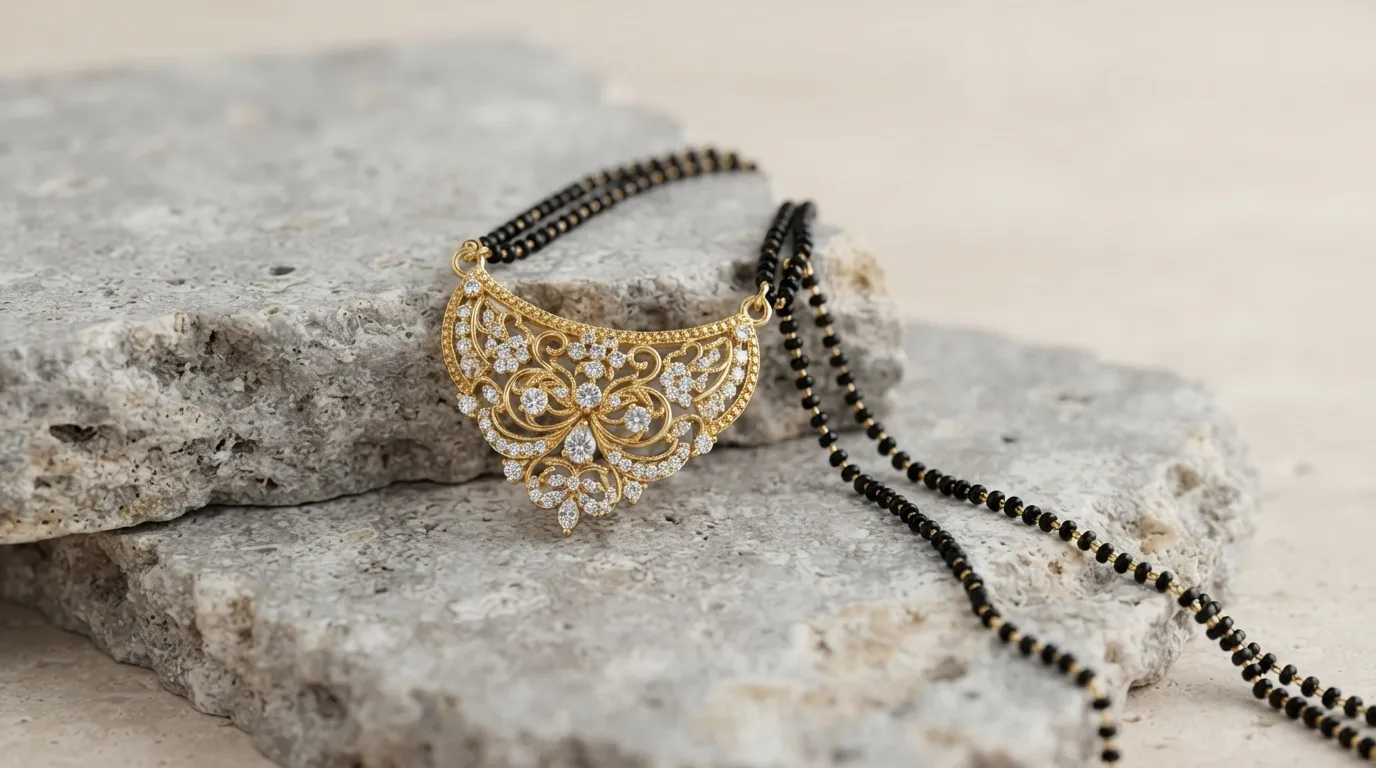
The pendant carries the design identity, so treat it as fine jewellery. Use a macro lens at f/8 to f/11, soft side lighting, and a pin board (white or black card with the lens poked through) to control what reflects in any diamonds or polished metal. For a diamond mangalsutra pendant, a black pin board deepens contrast and makes the stones pop; for a softer look, white works. Mount the camera on a tripod and focus carefully on the front facets of the central stone, since at macro distances depth of field is shallow and the point of focus decides whether the pendant reads as crisp or soft.
In the pendant macro, it is fine to let the black bead chain fall slightly out of focus so attention stays on the stones. You will show the beads sharply in the dedicated full-chain frame, so the macro can prioritise the pendant.
The full-chain frame
The full-chain frame shows the full design, the bead pattern, the spacer placement, and the proportion of pendant to chain. Lay the complete mangalsutra in the shape it naturally takes when worn, a gentle U or V, rather than a tight coil or a straight line. Shoot it straight down on white for marketplace use. Keep the chain's curve symmetrical; an uneven layout reads as carelessness on an expensive piece. Take a moment to check the spacing between beads is even along the whole length, because a bunched or stretched section is far harder to fix convincingly in post than to correct with a fingertip before the shot.
The on-model shot is not optional
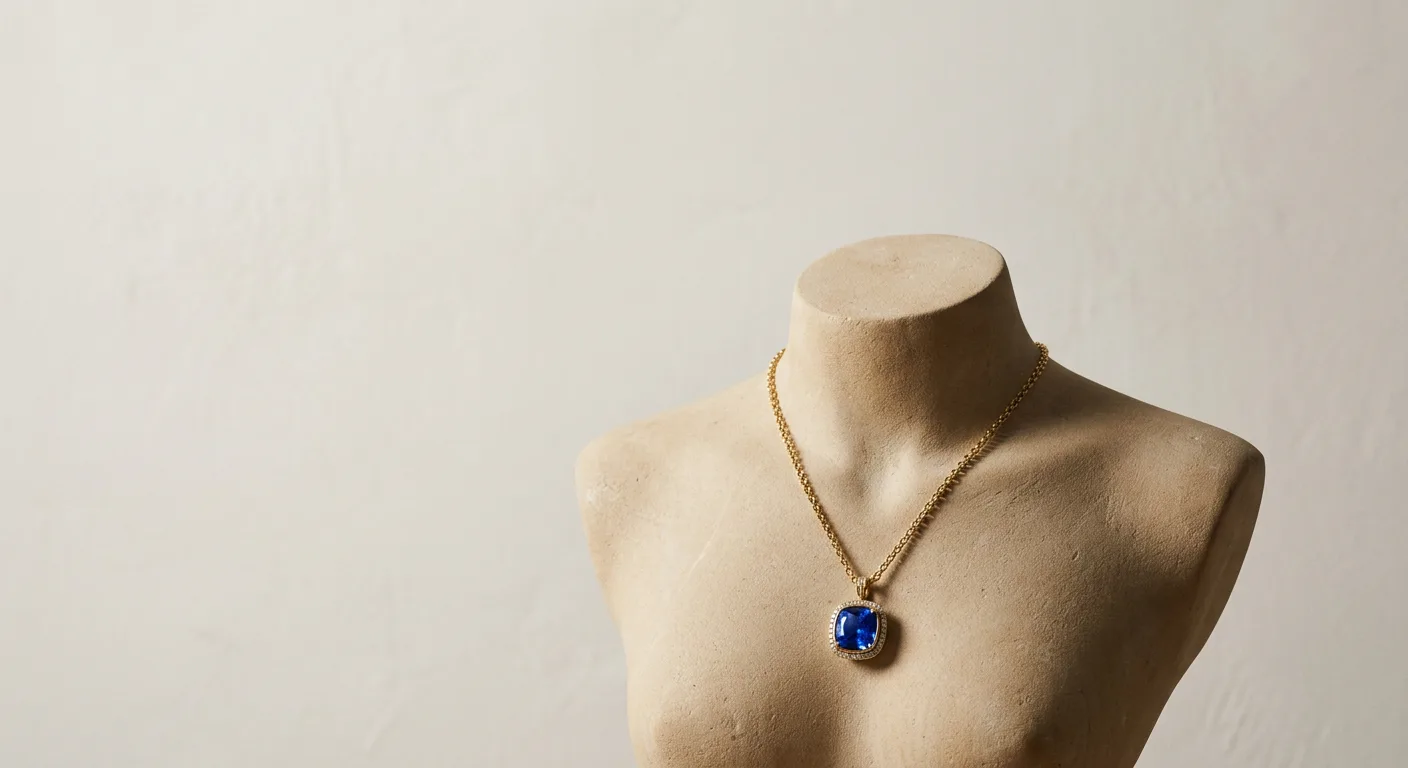
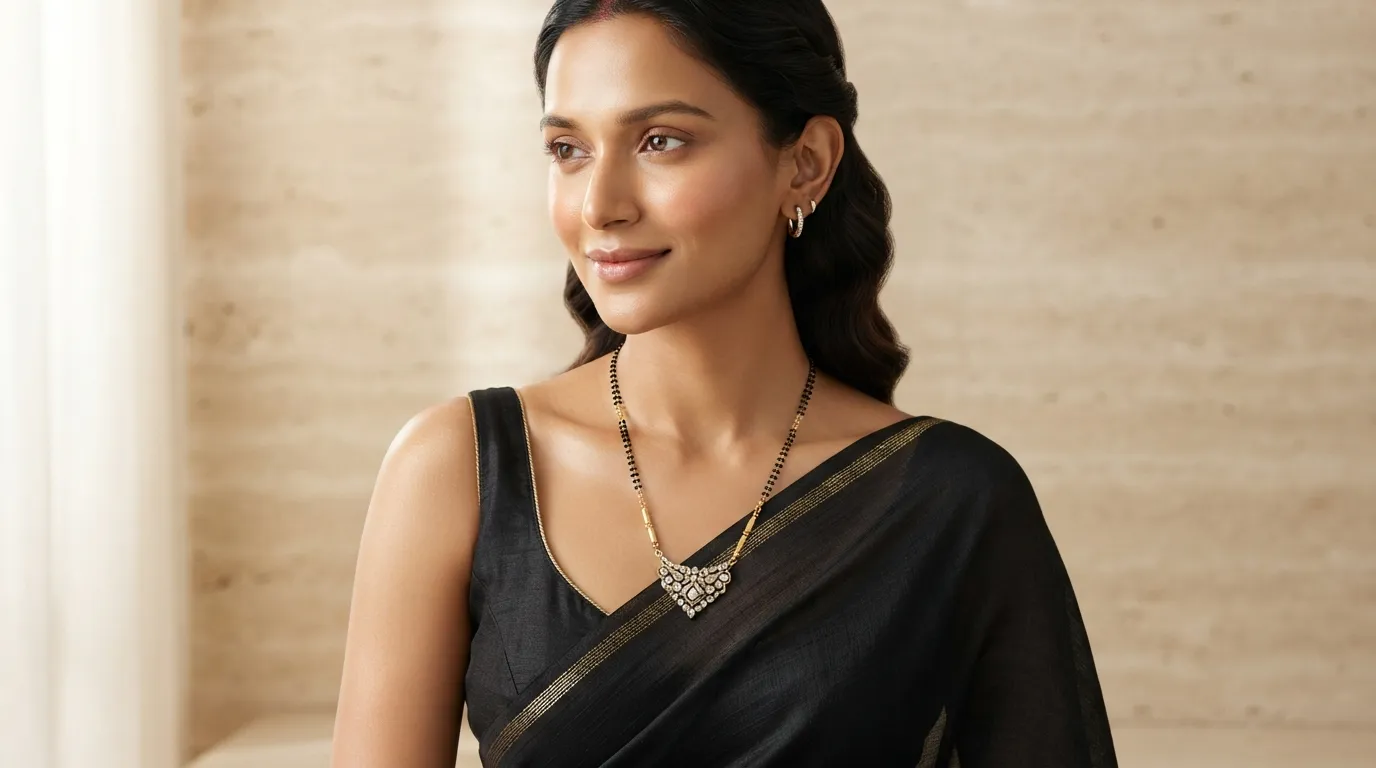
Length and drape are the defining attributes of a mangalsutra, and neither is visible in a flat-lay. A buyer needs to see whether the piece sits at collar length or drops to the sternum, how the pendant rests, and how the chain follows the neckline. This is why an on-model or on-bust frame is essential, and why several Indian marketplaces require on-body imagery for necklaces. Myntra, for instance, requires on-body shots for earrings, necklaces, and rings, with primary images on a pure white background.
If you sell several lengths, photograph each on the same model or bust with identical framing so buyers can compare drop points directly. A consistent on-model template across a range removes guesswork and reduces the returns that come from length surprises.
Booking models for every SKU is impractical, especially in the run-up to wedding season when you may be preparing dozens of new designs at once. Hylo's AI Photoshoot can place a mangalsutra on a model from your existing packshot, giving you the worn frame and the drape information without a studio day. Combine it with AI Retouch to clean the chain and even the background while keeping the black beads and gold true.
Marketplace rules that affect mangalsutra listings
Primary images on most Indian and global marketplaces must be on a clean white background with the product filling most of the frame. Flipkart asks for a 1:1 square at a minimum of 1000x1000px, recommended 2000x2000px, with the product occupying at least 85% of the frame. Myntra uses a 3:4 portrait ratio at a minimum of 1080x1440px on a pure white background, with on-body shots for necklaces. Always confirm the current spec for each platform, because requirements are periodically updated.
The practical implication is that a single shoot has to satisfy several different specs at once. A square crop for Flipkart, a 3:4 portrait for Myntra, and your own website's layout rarely share the same proportions. Shoot looser than the tightest crop you need, keep a high-resolution master of at least 2000px on the longest side, and derive each platform's version from that master rather than reshooting. This is also why an accurate, neutral white background pays off: a clean background crops and re-frames cleanly, whereas a slightly grey or uneven backdrop multiplies your editing work across every channel.
Styling and context frames that lift conversion
Beyond the functional frames, a mangalsutra benefits from one or two styled context shots, because the piece is bought for daily wear and for its symbolism. A context frame might show the mangalsutra against a saree neckline or paired with complementary pieces, helping the buyer imagine it in their own life. These frames belong in the secondary slots, never as the marketplace primary image, which must stay clean on white.
Keep context frames honest. The goal is to help the buyer picture the piece, not to disguise its true colour or scale. If the daily-wear version is lighter and shorter than the bridal version, show that difference clearly rather than implying every piece is a statement drop. Misleading styling is one of the quiet drivers of returns, and returns on personal pieces are especially costly to reputation.
Reusing mangalsutra imagery across channels
One well-built set of frames serves far more than the marketplace listing. The on-model drape frame headlines your website category page and works as Instagram feed content in a 4:5 crop. The pendant macro becomes a close-up reel or story in 9:16. The full-chain frame anchors a WhatsApp catalog entry. Because the cost of producing the imagery, whether through a physical shoot or Hylo's AI Photoshoot, is spread across every one of these uses, the per-channel cost drops sharply when you plan the crops up front.
This multiplication is the strongest argument for investing in the on-model frame even when it feels like the most expensive one to produce. It is the frame buyers most want to see, the one that reduces returns, and the one that works hardest across channels, so it earns its cost several times over.
Equipment and a repeatable per-SKU workflow
You can shoot a mangalsutra range with modest equipment if you prioritise correctly. A single large soft light, a tripod, and a way to hold the chain in a clean curve cover most of the work. The chain-holding method matters more than people expect: a sheet of non-reflective acrylic, a flocked board, or a slim jewellery ramp lets you arrange the U-shape and keep it symmetrical. Working flat on glass tends to create a hard reflection under the beads that you then have to remove in post. A macro lens helps for the pendant frame, and a grey card for custom white balance keeps the mix of black beads and warm gold from confusing the camera's automatic settings.
For the on-model or on-bust frames, a neutral mannequin bust in a skin-adjacent tone is repeatable and consistent: every piece sits at the same height and angle, so a buyer comparing two lengths sees a true comparison. A practical per-piece sequence keeps quality consistent and speed high: clean the piece, set it in its natural curve, capture the full-chain straight-down frame, switch to the macro for the pendant, move to the bust or model for the drape frame, and finish with a clasp detail. Locking your light and camera positions means each new piece drops into the same setup with only minor tweaks, which is what makes it realistic to clear dozens of designs before the October to February rush rather than during it.
Common mangalsutra photography mistakes
The most frequent mistake is front-lighting the black beads, which flattens them into a line; side light is the fix and it is non-negotiable for this style. The second is omitting the on-model frame entirely, which leaves the single most important attribute, length and drape, to the buyer's imagination and drives returns. The third is inconsistent framing across lengths, which makes comparison impossible and erodes trust in a range. The fourth is over-warming gold in post until the photo no longer matches the physical piece. Each of these is avoidable with a calibrated, repeatable setup, and each is a quiet driver of the returns that hurt margins and seller ratings on personal pieces.
Building the full listing
A complete mangalsutra listing should include: a pendant macro, a full-chain straight-down shot, an on-model or on-bust drape frame, a length or measurement graphic, and a clasp detail. Each frame answers a specific buyer question, length, design, drape, fit, and durability, and together they remove the doubts that stall a sale on a piece that carries this much personal meaning.
Treat the listing as a sequence that walks the buyer from desire to confidence: the pendant macro creates the want, the full-chain frame shows the design honestly, the on-model frame answers the fit question, and the clasp and measurement frames close the practical doubts. A listing built this way outperforms one with five near-identical flat-lays, because it anticipates and answers questions instead of leaving them open.
Finally, keep the whole set visually consistent with the rest of your store. A mangalsutra rarely sells in isolation; buyers often arrive from a bridal set, a pair of jhumkas, or a category page, and the imagery should feel like part of one coherent collection. The same background tone, the same gold rendering, and the same framing logic across pieces signal a considered brand, which matters more on emotionally significant purchases than on commodity ones. When the photography is consistent and complete, the mangalsutra listing does its job: it removes doubt and lets the meaning of the piece carry the sale.
Try Hylo free — no studio booking required.