
Jewelry is one of the most seasonal categories there is. Sales do not arrive evenly across the year; they concentrate in a handful of predictable windows, and a large share of annual revenue can depend on how well a business prepares for them. The businesses that win these windows are not the ones that work hardest during the spike, they are the ones that did the work weeks earlier. A seasonal content calendar is how you make that preparation systematic instead of frantic.
The spikes worth planning for
For sellers serving Indian buyers, the dominant rhythms are the wedding season and the gold-buying festivals. Diwali is a major jewelry-buying period, and Akshaya Tritiya holds a special place as a day traditionally considered one of the most auspicious of the year to buy gold, driving a pronounced surge in gold purchases. The wedding season concentrates enormous demand for bridal sets, mangalsutras, jhumkas, and Kundan and Polki pieces into a few months. For global and Western markets, Valentine's Day drives romantic and gift jewelry, and the end-of-year holiday season is the big gifting window. Most jewelry businesses can name the three or four dates that make their year, and those dates are the skeleton of the calendar.
Why ahead-of-time is the whole point
The central discipline is simple and counterintuitive: do the content work before the spike, not during it. When demand peaks you are consumed by fulfilment and customer service, with no capacity to produce good imagery or thoughtful campaigns, and anything made under that pressure is rushed. Buyers also start researching well before the occasion itself, so your listings need to be complete and your marketing live as that research begins, not after the peak has passed. Preparing in advance is what separates capturing a spike from merely surviving it.
Building the calendar
Start by mapping the occasions that actually drive your sales, based on the markets you serve, then match the right pieces to each: festive and bridal sets for the wedding season and Diwali, romantic pieces for Valentine's, giftable items for the holidays. Then work backward from each date to set production deadlines, allowing time to produce imagery, build or update listings, and schedule social content so everything is ready before buyers start looking. This backward planning turns a vague intention to "do something for Diwali" into concrete deadlines weeks ahead.
Seasonal content sits alongside, not instead of, evergreen content. Seasonal pieces tie to the moment with imagery and messaging that match the occasion, and they capture the spike; evergreen content sells your pieces on their own merits year-round and sustains the baseline between peaks. You want both running.
A month-by-month view of the jewelry year
It helps to see the year as a sequence of overlapping demand windows rather than a few isolated dates, because the preparation for one often overlaps with the selling of another. The early part of the year, leading into February, is shaped by Valentine's Day in Western and increasingly Indian markets, driving romantic pieces, pendants, and gifting jewelry. Spring brings Akshaya Tritiya, typically falling in April or May, one of the most auspicious gold-buying days in the Indian calendar and a major surge for gold specifically. Through the year the wedding season exerts a continuous pull, with regional variation, but it intensifies dramatically in the second half.
The largest concentration for Indian sellers arrives in autumn: the festival season culminating in Diwali, usually in October or November, which is both a gifting occasion and an auspicious buying period, flowing almost directly into the peak wedding months. For global markets, the end-of-year holiday season, Christmas and the gifting run through December, is the single biggest window. Mapping these onto a calendar reveals that a jewelry business is rarely far from a spike, and that the quiet periods between them are precisely when the next spike's content should be produced. Seeing the year this way turns seasonal planning from a series of last-minute scrambles into a rolling production schedule.
Working backward from each spike
The core planning discipline is to work backward from each demand window to the dates by which work must be finished. Buyers do not begin purchasing on the day of a festival; they begin researching well before it, comparing pieces, reading, and shortlisting, often weeks ahead for a considered purchase like bridal jewelry. This means your listings must be complete and your campaigns live as that research phase begins, not as the festival arrives. If your Diwali collection goes live the week of Diwali, you have missed the research and decision period when the buyer actually chose.
Working backward, you set a sequence of internal deadlines: the date the collection must be finalised, the date imagery must be complete, the date listings must be built and live, and the date social content must be scheduled. Each of these sits progressively earlier than the spike. The imagery deadline is usually the binding constraint, because everything downstream, listings, ads, social, depends on having the images ready. A realistic backward plan accounts for the fact that producing imagery for a large seasonal range takes time, and that this time falls in a period when you are also managing inventory and the tail of the previous spike.
Matching pieces, imagery, and messaging to each occasion
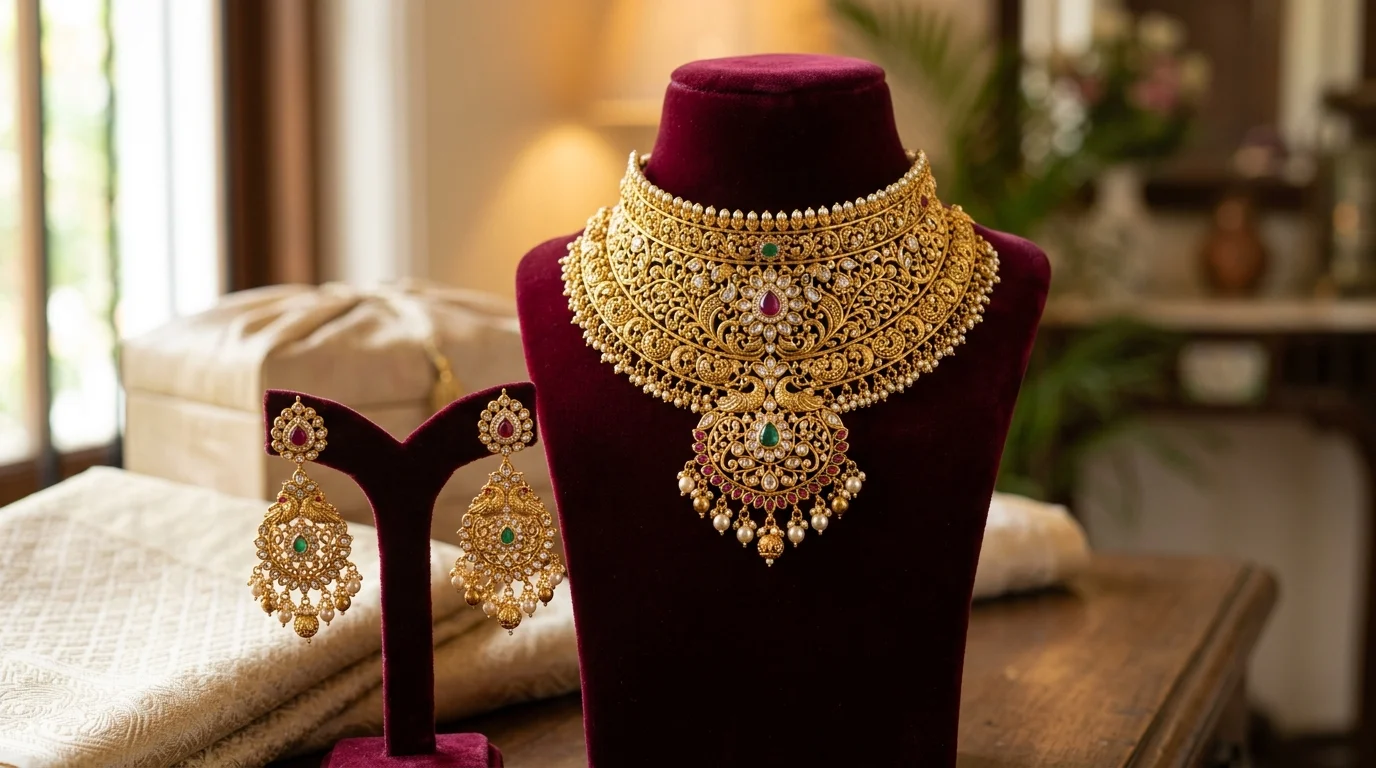
Seasonal content is not simply your normal catalog with a festive banner; it is a deliberate match of pieces, imagery, and messaging to the occasion's meaning. The wedding season calls for bridal sets, mangalsutras, jhumkas, and Kundan and Polki pieces, shown in a way that connects to bridal aspiration, often on-model and richly styled. Akshaya Tritiya and Diwali call for gold pieces framed around auspiciousness and value, with accurate gold tone mattering especially because buyers are partly buying gold as worth. Valentine's calls for romantic pieces, pendants, solitaires, couple-oriented gifting, with warmer, more emotional imagery. The year-end holidays call for giftable items presented with gifting cues like packaging and ready-to-give framing.
The imagery should reflect these differences, which is why seasonal content genuinely requires production rather than reuse. A bridal set needs on-model styling that conveys the occasion; a Valentine's pendant needs an emotional, gift-oriented presentation; a Diwali gold piece needs accurate, value-signalling tone and perhaps festive context. Messaging follows the same logic, tying each piece to the moment the buyer is shopping for. This is what makes seasonal content convert: it meets the buyer in the specific emotional and practical context of the occasion, rather than asking them to imagine how a generic catalog image fits their festival or gift.

The capacity problem at the heart of seasonality
The reason seasonal planning so often fails is not a lack of awareness but a lack of capacity at exactly the wrong moment. The weeks before a major spike are when you most need new imagery and when you have the least time to produce it, because you are simultaneously sourcing inventory, fulfilling the previous wave of orders, and handling customer service. Booking studio shoots for an entire seasonal range in that window is frequently impossible: studios and models are in high demand from every other seller doing the same thing, lead times stretch, and any delay cascades into late listings that miss the research period. This capacity crunch is the single biggest reason good seasonal intentions go unrealised.
Solving it requires either producing far in advance, which ties up resources and is hard when collections are finalised late, or producing far faster than traditional photography allows. Generating imagery and video from product photos addresses the crunch directly, because it decouples image production from studio and model availability and compresses the time from finished piece to finished listing. A seller who can turn a newly finalised bridal set into a full set of on-model images and a social video in a fraction of the usual time can finalise collections later and still hit the live dates, which is exactly the flexibility the seasonal calendar demands.

Coordinating channels around each spike
A seasonal calendar is most powerful when the channels reinforce each other around the same window rather than acting in isolation. The listings are the destination, the place the sale actually happens, and they must be complete and accurate before any traffic is driven to them. Social content is the demand generator, building awareness and desire in the research phase, and it should point clearly toward the listings. Email and existing-customer outreach, if you have it, reaches the people most likely to buy and should be timed to the same window. Paid promotion, where used, amplifies the reach during the peak. When these fire in a coordinated sequence, listings live first, social building in the run-up, outreach and ads at the peak, the spike is captured efficiently; when they are uncoordinated, effort leaks away, ads drive traffic to incomplete listings, or social peaks after the buying window has closed.
This coordination is itself a reason to plan and produce ahead. You cannot coordinate channels you are still scrambling to populate, and the imagery that every channel depends on is the common input. A listing needs clean product shots, social needs on-model images and video, ads need attention-grabbing creative, and all of it traces back to the same underlying photography of the seasonal range. Producing that imagery early and in a form that can be cut for every channel is what makes a coordinated seasonal push possible rather than a set of disconnected last-minute efforts.
Learning from each cycle
Because the spikes recur every year, a seasonal calendar should be a living document that improves with each cycle rather than a fresh scramble each time. After each major window, note what worked, which pieces sold, which imagery and messaging drove engagement, which channels delivered, and which deadlines slipped, and feed those lessons into next year's plan for the same occasion. Over a few cycles this builds a reliable playbook: you know roughly when to start, which pieces to prioritise, how much imagery you need, and where the bottlenecks appear. The festivals and gifting occasions do not change, so the institutional knowledge of how to prepare for them compounds, turning what was once an annual panic into a repeatable, refined process.
This is also where keeping the bottleneck, imagery production, fast and flexible pays off year over year. A seller who has solved the capacity crunch can act on the lessons of past cycles, finalising collections at the optimal time and still hitting live dates, rather than being forced by long production lead times into the same last-minute compromises every season. The calendar, the channel coordination, and the fast imagery production together turn seasonality from the most stressful feature of the jewelry business into one of its most predictable and capturable opportunities.
A simple framework to start
If a full year-long calendar feels daunting, start with the single biggest spike for your market, Diwali and the wedding season for Indian sellers, the year-end holidays for Western ones, and build the discipline around that one window first. Identify the date, work backward to set your imagery, listing, and content deadlines, decide which pieces to feature, and commit to having everything live before the research period begins. Getting one spike right teaches you the realistic lead times and capacity your business needs, and that knowledge transfers directly to the next occasion. Each window you prepare for properly makes the following one easier, until preparing ahead of demand becomes the default way you operate rather than an annual ambition.
The payoff for this discipline is substantial and compounding. A jewelry business that reliably captures its three or four major spikes, with complete listings, coordinated channels, and imagery that matches each occasion, can earn a disproportionate share of its annual revenue in those windows precisely because so many competitors are caught scrambling. The seasonal calendar is not administrative overhead; it is the operating system of a jewelry business that understands its own demand and prepares to meet it.
Making the calendar achievable
The reason seasonal calendars often stay aspirational is the imagery bottleneck. Producing images, on-model shots, and video for a large seasonal range, in the weeks before a spike when you are also preparing inventory, is exactly where booking studio shoots for every piece falls apart. This is where generating content from product photos changes what is possible: Hylo's AI Photoshoot can produce the catalog and on-model imagery for a seasonal range, and image-to-video generation can add the motion that performs well on social during these high-attention periods, all from product photos and without scheduling shoots for each piece. That turns the calendar from a plan you hope to execute into one you can actually deliver, ready before each spike rather than chasing it. The jewelry year is predictable in a way few other businesses enjoy; the festivals, weddings, and gifting occasions arrive on schedule every year, telling you exactly when demand will come. The only real question is whether your catalog and content will be ready to meet it, and that question is answered weeks in advance, by the seller who treated the calendar as a production plan rather than a wish. Start now, with the next spike on your calendar, and let each cycle make the following one easier.