
Jhumka and jadau earrings present a specific commercial problem rather than just a technical one. These are catalog-heavy products: a single bridal brand might carry dozens or hundreds of designs, from small everyday jhumkas in 18k yellow gold to elaborate jadau bridal pairs set with uncut stones and hung with pearls. And the demand is sharply seasonal, concentrated in the October to February wedding window. That combination, high SKU count and a hard seasonal deadline, means the photography workflow has to be fast and repeatable without sacrificing the detail that sells a premium earring.
This page covers how to shoot jhumka and jadau earrings so the shape, stonework, and scale all read, and how to get an entire wedding-season range camera-ready before the rush begins. The principles apply equally to lightweight everyday jhumkas and to heavy bridal jadau pairs, with the emphasis shifting toward scale and comfort detail as the pieces get larger.
The shape problem: why flat-lays fail jhumkas
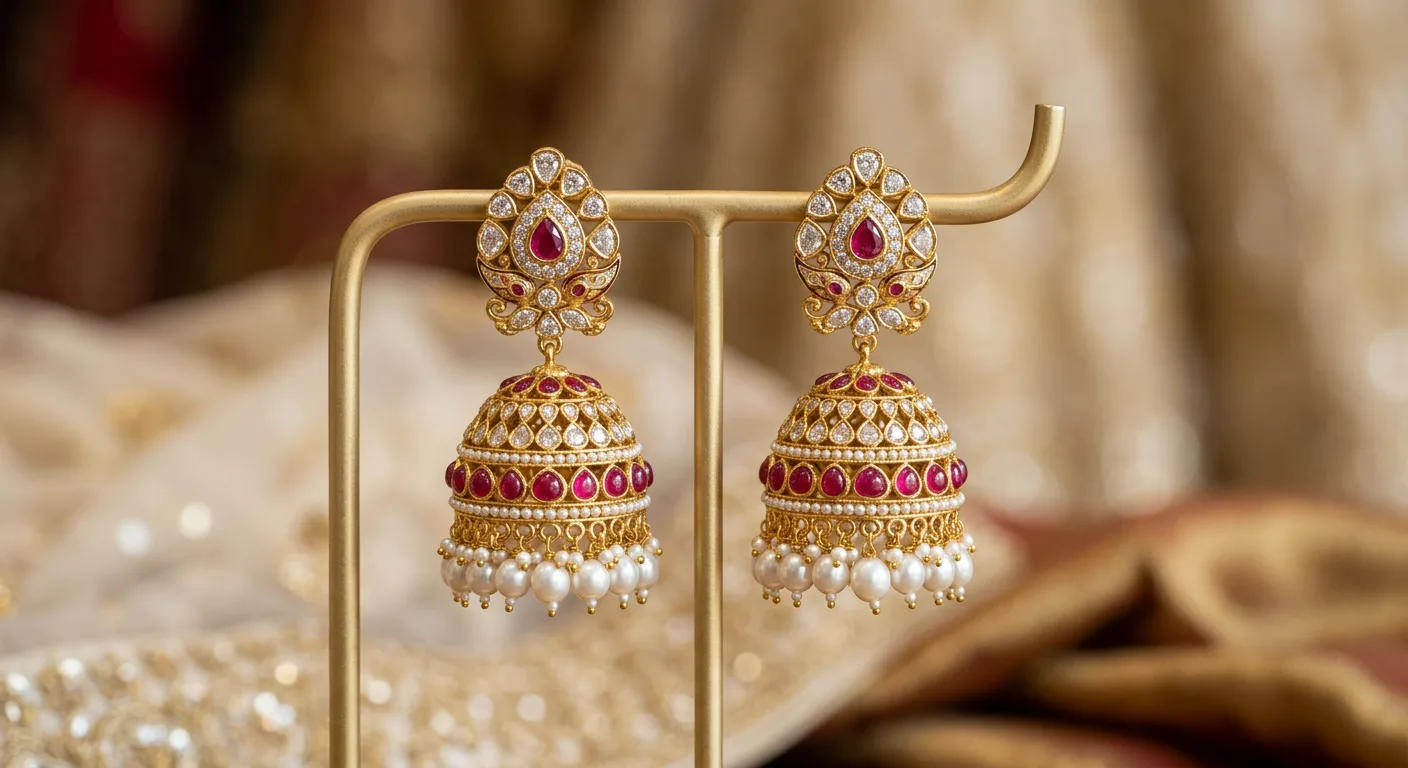
A jhumka's signature is its three-dimensional dome, the bell shape that gives the earring its name and its movement. Lay a pair flat on a table under front light and that dome disappears; you get a flat circle that could be any earring. The fix is to hang the pair so it sits as it would when worn, then light from the side. Side light rakes across the dome's curve, revealing its roundness, and catches the texture of any jadau stone setting or meenakari enamel on the surface.
Hanging also lets the danglers, the pearls, beads, or small chains around the dome's rim, fall naturally. These elements are part of the design and the price, and they only look right when gravity is doing its job. A simple acrylic stand or a thin wire rig holds the pair at the correct height and angle. Make sure the rig itself stays out of the frame or sits where it is easy to remove cleanly in post, because a visible hook or wire in the marketplace primary image looks unfinished and can fall foul of platform rules about extra objects.
Lighting jadau stonework and soft pearls together
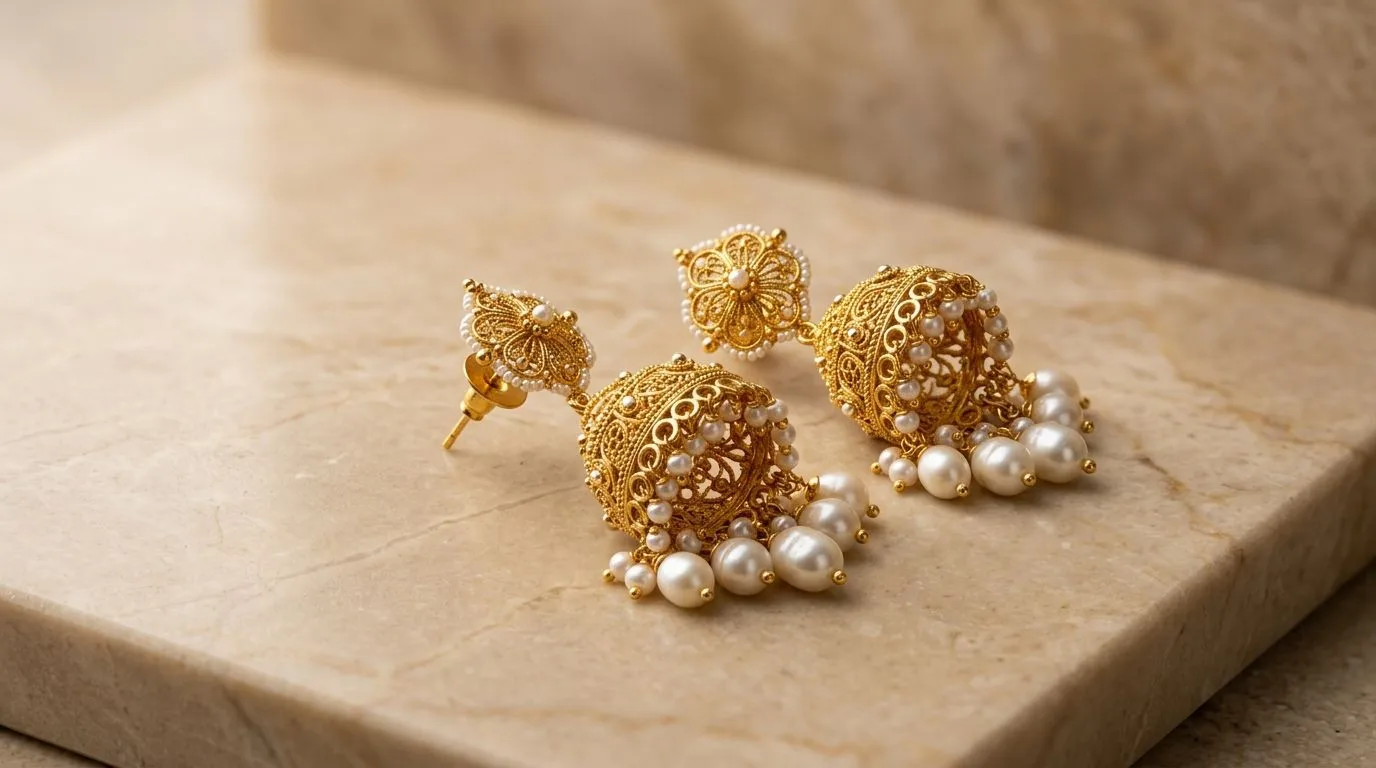
Jadau earrings combine two surfaces that want different light: uncut jadau stones, which behave like Polki and need angled light to show texture, and pearls or beads, which have soft luster and need broad, soft light to show sheen without a harsh hot spot. A single large side light, slightly above the piece, with a fill card below to open the shadows under the dome, satisfies both. The fill is important because the danglers hang in the dome's shadow, and without fill they go muddy.
For metal, most jadau is high-karat yellow gold, often 22k, which is warmer than Western 14k or 18k gold. Set white balance off a grey card so the gold renders true. If your range mixes gold with rose gold or sterling silver pieces, reset white balance per metal.
Controlling reflections in a complex piece
Jhumkas are reflective in several directions at once: the smooth gold dome, the faceted or uncut stones, and the polished danglers each bounce light differently. The risk is a scatter of distracting hot spots that compete with the design. Use flag cards, small pieces of black card placed just out of frame, to subtract reflections from the parts of the dome that are catching too much light, and a soft fill to lift the parts that fall dark. The aim is a controlled gradient of light across the dome that describes its curve, not a field of competing sparkles.
A polariser can help on the metal if reflections are stubborn, but use it judiciously, because over-polarising kills the life in the stones and pearls along with the unwanted glare. As with all jewellery, watch the live view and adjust the piece or the light a few degrees at a time rather than reaching for heavy correction in post.
Building a setup you can repeat hundreds of times
For a large catalog, consistency is what makes the work feasible. Lock one setup, a hanging position at a fixed height, a fixed side light, a fixed camera on a tripod, and a consistent white background, then move pairs through it one after another. When every frame is shot identically, you can batch your editing too, applying the same crop, exposure, and background cleanup across the set rather than fixing each image individually.
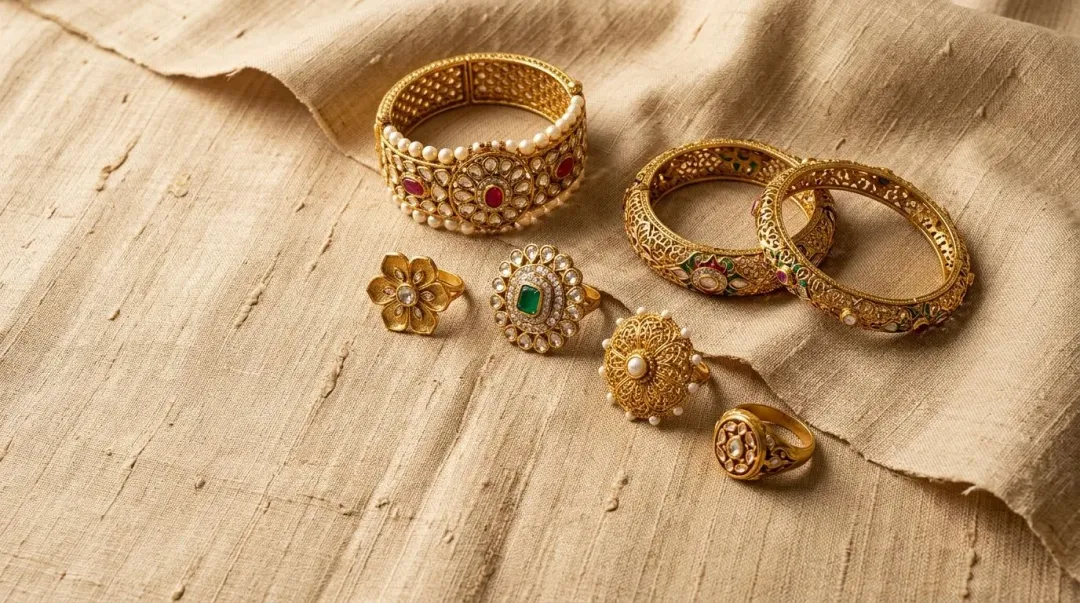
This is also where the on-ear scale frame usually becomes the bottleneck. Buyers consistently want to know how large a pair actually is, because jhumkas span a huge size range, and an on-ear shot is the clearest answer. Booking an ear model for every one of a hundred SKUs is neither fast nor affordable. Hylo's AI Photoshoot can place each pair on a model from your hanging packshot, so you get a consistent on-ear scale frame for the entire range without a per-SKU shoot. AI Retouch then cleans stray reflections and evens the background while keeping the jadau stones and gold accurate.
What a wedding-season earring listing needs
For each pair, plan three frames at minimum: a hanging pair on white for the marketplace primary image, a macro of the jadau stonework or dome detail to carry the craftsmanship, and an on-ear scale frame. Wedding-season buyers browse many near-identical pairs, so the detail and scale frames are exactly what move your listing ahead of a competitor who posted a single flat shot.
If you also run social and campaign content, shoot or generate a second set on deep maroon or green velvet, which flatters jadau's uncut stones and pearls and echoes the bridal context. Keep these separate from your marketplace images, which need the clean white background that platforms require. Plan the crops up front so one capture serves the square marketplace primary, a 4:5 portrait for the feed, and a 9:16 vertical for stories and reels, rather than reshooting each pair for every channel.
Handling weight and movement in the frame
Jhumkas are often heavy, and that weight is part of what a buyer is judging, both as a sign of substance and as a practical comfort question. While a still image cannot show weight directly, it can imply it through honest scale and through showing the ear-wire or hook clearly. Include a frame that shows the post, hook, or screw-back fastening, because comfort and security matter for a heavy hanging earring and buyers actively look for that detail.
Movement is the other quality jhumkas are prized for: the danglers swing and catch light when worn. A still catalog cannot animate that, but a short product video can, and listing video is increasingly rewarded across marketplaces and social. A simple clip of the pair gently swinging on a stand, or worn and turning, communicates the liveliness that a flat image cannot. This is a natural place to extend your imagery into motion using the same master assets.
Avoiding the common jhumka mistakes
Three mistakes recur in jhumka listings. The first is photographing the pair lying flat, which collapses the three-dimensional dome and tangles the danglers; always hang the pair. The second is flat front lighting, which kills the dome's curve and the texture of the jadau stones; light from the side with a fill below. The third is omitting the on-ear scale frame, which leaves the buyer guessing about size on a category where size varies enormously and surprises drive returns. Each is simple to avoid once the setup is fixed.
A subtler mistake is inconsistency across a large range. When one pair is shot slightly larger, brighter, or warmer than the next, the store looks disorganised and buyers lose confidence. A locked, repeatable setup and batch editing keep the whole catalog visually coherent, which is itself a quiet conversion advantage during a competitive season.
Beat the season, don't shoot during it
The core commercial insight is timing. Demand for bridal jhumka and jadau peaks in a narrow window, which means the catalog must be ready before the window opens. Brands that try to shoot new designs during the season lose selling days to studio scheduling and editing. Preparing the full range ahead of time, using a repeatable setup for packshots and Hylo's AI Photoshoot for the on-model and on-ear frames, means your listings are live and complete when buyers start searching.
Try Hylo free — no studio booking required.