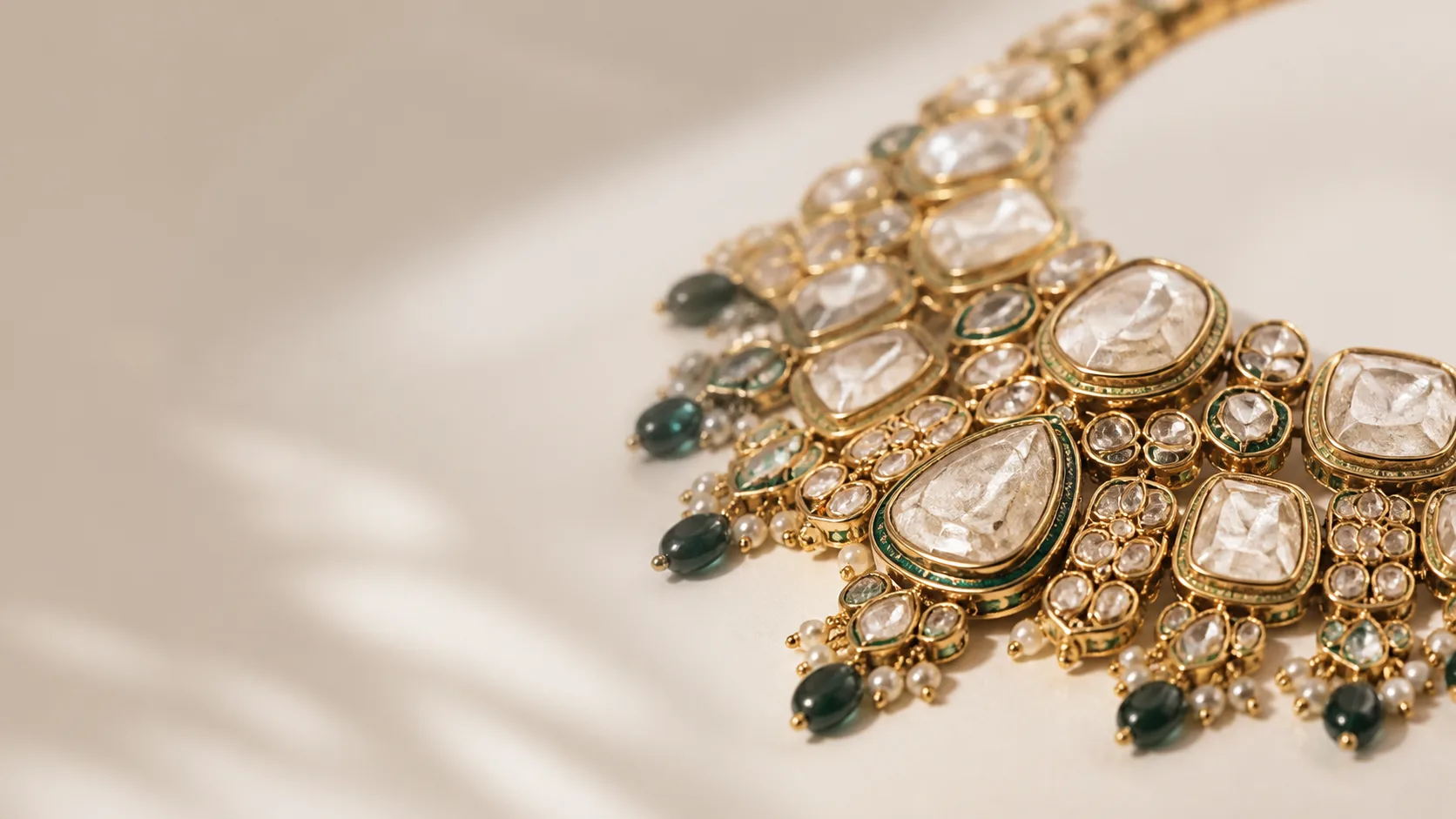
Kundan and Polki are among the hardest jewellery styles to photograph well, and the reason is built into how they are made. In Kundan work, each stone is set with a thin sheet of pure gold foil pressed behind and around it. That foil is essentially a mirror, designed to throw light back through the stone so it glows when worn under candlelight or sunlight. Under a camera and a hard studio light, that same mirror becomes a problem: it blows out to pure white, kills the stone's detail, and flattens the whole piece. Polki adds a second challenge because the stones are uncut, natural diamonds with flat or lightly polished faces rather than brilliant facets, so they reflect far less light and can photograph as dull grey patches.
This guide covers how to light, expose, and frame these pieces so the foil glows instead of glaring, the uncut stones keep their texture, and the meenakari enamel work that often sits on the reverse actually gets seen. The techniques apply equally to a single Kundan ring in 22k gold or a full Polki bridal set worth several lakh.
Why Kundan and Polki break normal jewellery lighting
Most jewellery lighting advice assumes faceted stones and reflective metal. A brilliant-cut diamond or a high-polish white gold band scatters light in many directions, so a single light reads as sparkle. Kundan and Polki behave differently. The gold foil behind a Kundan stone reflects light like a flat mirror, which means it shows your light source as a single bright shape. Point a hard light straight at it and you get a harsh white blob where a glowing stone should be.
The fix is large, soft, and angled light. A big diffused source wraps around the piece, and angling it means the mirror reflection bounces off to the side instead of into your lens. The bigger and softer the light relative to the piece, the more the foil reads as an even glow rather than a hot spot. This is also why daylight near a large window, heavily diffused, can outperform a small on-camera flash for these styles.
Polki needs the same soft light but for the opposite reason. Because the stones are uncut, they have subtle surface texture rather than sharp facets. Side light rakes across that texture and reveals it; head-on light flattens it. A 22k yellow gold Polki necklace lit from roughly 30 to 45 degrees to one side will show the natural character of each stone, while the same piece lit flat from the front looks lifeless.
The lighting setup that works
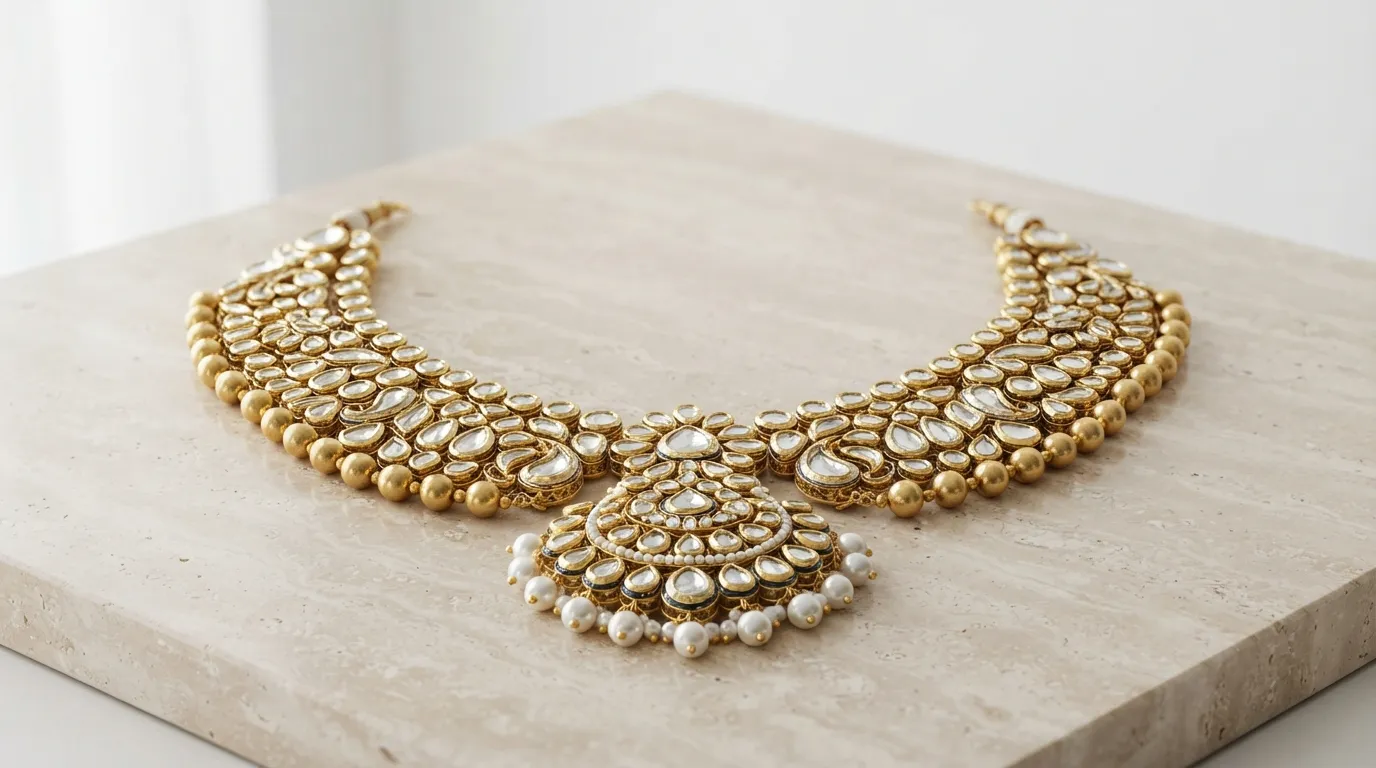
Start with one large diffused light, not many small ones. A single softbox or a diffusion panel in front of a strobe, placed to one side, gives you control and a clean, single set of reflections. Add a white bounce card on the opposite side to lift the shadows so the gold does not go muddy. This two-piece setup, one soft key light and one fill card, handles the majority of Kundan and Polki work.
Watch the reflections in your live view as you move the light. The goal is to turn the bright mirror hot spots on the foil into soft, controlled highlights. Nudge the light a few degrees, or rotate the piece slightly, until the worst glare slides off the stones. This small adjustment is the difference between an amateur and a catalog-ready frame, and it costs nothing.
For metal tone, remember that most of these pieces are high-karat yellow gold, often 22k, which reads warmer and more saturated than the 14k or 18k yellow gold common in Western jewellery. Set a custom white balance off a grey card so the gold renders true. If you are also shooting pieces in rose gold or sterling silver in the same session, reset white balance rather than assuming one setting fits all metals.
Exposure and aperture for full pieces
Bridal Kundan and Polki sets are large and detailed, and buyers want to see the whole piece sharply. Shoot at f/11 to f/16 so the depth of field covers the piece from the central pendant to the outer links. This is wider depth than typical product work because the piece itself has depth when it sits in its natural curve. A single ring or small jhumka can be shot at f/8.
Because you are stopping down, use a tripod and a low ISO of 100 to 200 to keep the image clean during the longer exposure. Expose for the highlights: meter so the brightest foil and stone reflections sit just short of clipping. Recovering a blown Polki stone in post is usually impossible because there is no detail left to recover, whereas lifting the gold's shadows is easy. Check your histogram and keep the right edge off the wall.
Don't skip the reverse: meenakari and craftsmanship frames
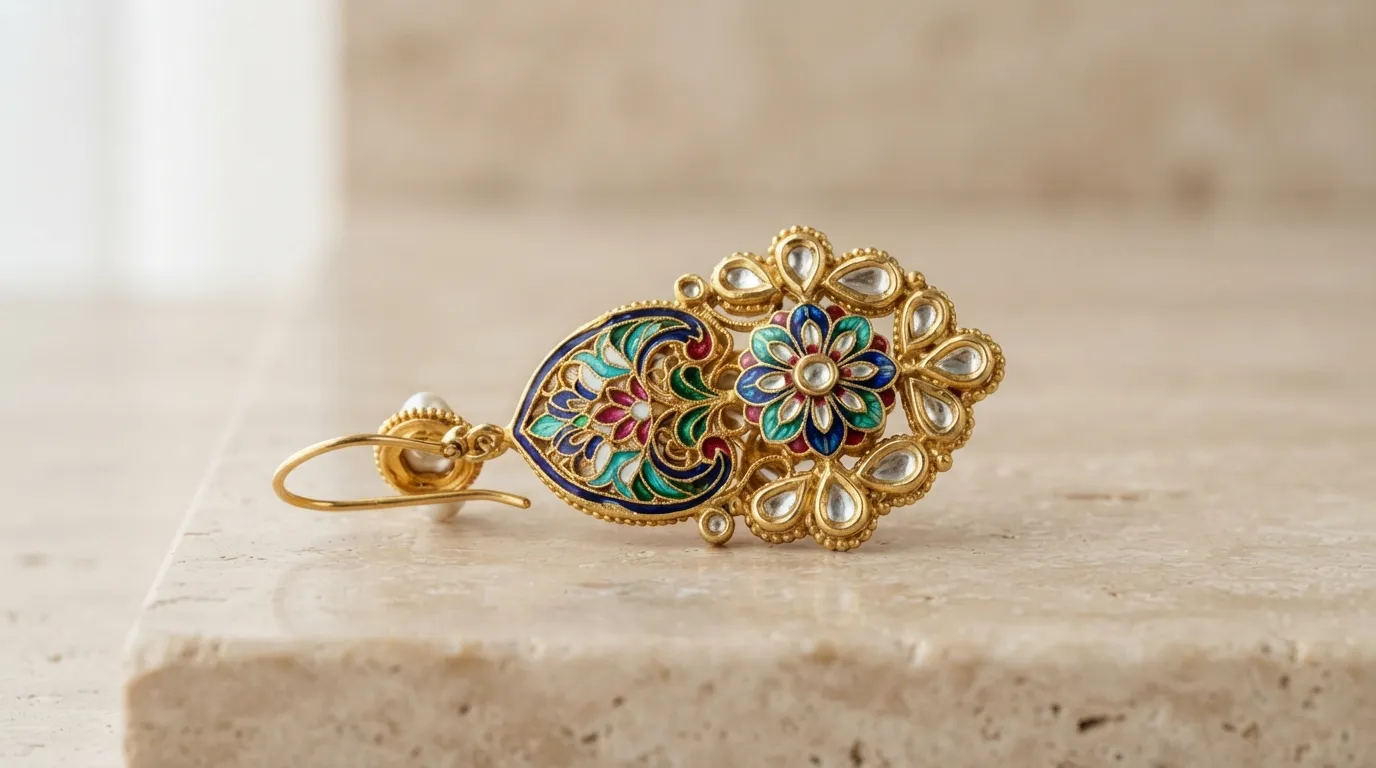
A defining feature of fine Kundan and Polki jewellery is meenakari, the coloured enamel work often applied to the reverse of pendants, earrings, and haars. For a bride choosing a set, that hidden colour is part of the value, and most listings never show it. Shoot a dedicated straight-down frame of the reverse, lit evenly so the glossy enamel does not develop hot spots. The same applies to the central stone, which deserves a macro, and the clasp, which signals build quality.
These detail frames are where you build trust. A buyer comparing two similar Polki chokers will choose the one that shows the meenakari, the central uncut stone up close, and a secure clasp, because those frames answer the questions that stop a purchase.
Scale and drape: why flat-lays aren't enough
A heavy rani haar photographed flat on a table tells the buyer almost nothing about how it will sit on the neck, how far it will drop, or how it drapes. For bridal pieces especially, scale and drape questions drive both hesitation and returns. Show the piece on a neck or a bust form. On-model shots are required as primary or secondary images for earrings, necklaces, and rings on several Indian marketplaces, and they convert better everywhere.
Booking a bridal model shoot is expensive and slow, particularly when you are preparing dozens of sets before the October to February wedding season. Hylo's AI Photoshoot can place a piece on a model from your existing packshot, preserving the stone and foil detail you captured, so you get the scale and drape frame without the studio day.
Pair it with AI Retouch to clean dust and stray reflections while keeping gold tone and stone colour accurate to the physical piece.

The equipment that actually matters
You do not need a large studio to shoot Kundan and Polki well, but a few things matter more than the camera body. The largest soft light source you can manage is the highest-priority purchase: a 60cm or larger softbox, a diffusion panel, or even a north-facing window with a sheer curtain. A sturdy tripod is non-negotiable because you will be shooting at f/11 or smaller with low ISO, which means slower shutter speeds where any handheld shake destroys the fine detail you are working so hard to capture.
A macro-capable lens earns its place for the stone and meenakari detail frames. A dedicated macro lens in the 90mm to 105mm range lets you fill the frame with a single Polki stone or a section of enamel without distortion. If you do not own one, a longer focal length combined with a tripod and careful cropping from a high-resolution file is a workable substitute. A grey card for custom white balance is cheap and saves hours of colour correction later, especially when you are switching between 22k yellow gold, rose gold, and sterling silver pieces in one session.
A few small accessories punch above their cost. Black and white bounce and flag cards let you add or subtract reflections in the foil precisely. A pair of clean cotton gloves and a microfibre cloth keep fingerprints off polished gold and stones, which is far faster than removing them in post. A small lump of museum putty or a few jewellery props hold rings and earrings at the angle you want instead of fighting gravity.
Common mistakes that flatten Kundan and Polki
The single most common mistake is lighting too hard and too close. A bare flash or a small light source turns every foil-backed stone into a white blob and every gold surface into harsh streaks. The fix is always the same: make the light bigger and softer, and move it back. If your highlights are still blowing out, you are too close or too direct.
The second mistake is shooting everything head-on. Front lighting is convenient but it is the worst choice for these styles because it flattens Polki texture and mirrors your light straight into the lens off the Kundan foil. Commit to side light at 30 to 45 degrees as your default and only deviate when a specific piece calls for it.
The third mistake is over-warming the gold in post. High-karat Indian gold is already warm and saturated, and the temptation to push it warmer to look luxurious backfires when the real piece arrives looking less orange than the photo. Returns driven by colour mismatch are expensive and damage seller ratings. Calibrate to a grey card and trust accurate colour over flattering colour.
The fourth mistake is skipping the reverse and detail frames to save time. These are exactly the frames that differentiate a premium listing, and competitors almost never include them. The few extra minutes per piece pay back in conversion and fewer pre-purchase questions.
Post-processing without falsifying the piece
Retouching Kundan and Polki is about cleanup and recovery, not transformation. Start by removing dust, lint, and stray fibres, which show up mercilessly on macro shots of dark enamel and polished gold. Even out the background to a clean white or remove it entirely for marketplace primary images. Recover shadow detail in the gold so the metal reads rich rather than muddy, but stop short of brightening the Polki stones to the point where they lose the grey-toned character that makes them authentic uncut diamonds.
Colour accuracy is the line you do not cross. The gold tone, the green and red of the meenakari, and the warmth of the stones should match the physical item under neutral light. Hylo's AI Retouch handles dust removal, background cleanup, and shadow recovery while keeping colour faithful, which is faster than manual masking for a large catalog and more consistent across a range. Consistency matters: a buyer scrolling your store should see the same gold tone and background treatment on every piece, not a patchwork of edits.
Shooting once, publishing everywhere
A single bridal set has to appear on a marketplace listing, a website category page, an Instagram grid, and possibly a WhatsApp catalog. Each wants a different crop and aspect ratio. Shoot a little looser than you think you need so you have room to crop to a square for marketplaces, a 4:5 portrait for Instagram feed, and a 9:16 vertical for stories and reels without re-shooting. Keeping a high-resolution master of at least 2000px on the longest side means you downscale per channel rather than upscaling a small file, which always looks soft.
This is also where on-model frames multiply in value. One good on-model shot of a rani haar can anchor the listing, headline the category page, and become a reel, so the cost of producing it, whether through a physical shoot or Hylo's AI Photoshoot, is spread across every channel rather than charged to a single listing.
A note on compliance for Indian sellers
If you sell gold Kundan and Polki within India, your pieces fall under BIS hallmarking rules. As of 2 March 2026, sale of hallmarked gold jewellery is mandatory across 380 notified districts, and every hallmarked item must carry the BIS logo, the purity grade such as 22K916, and a six-digit alphanumeric HUID. Photography does not change your hallmarking obligation, but a clean macro of the hallmark can reassure buyers and reduce questions. Do not photoshop or fabricate a hallmark; show the real one.
Putting it together
The whole approach comes down to a few decisions: light large and soft from the side, angle the reflection away from the lens, stop down to f/11–f/16 for full pieces, expose for the highlights, and always shoot the reverse, the central stone, and an on-model frame. Get those right and a Polki set photographs like the heirloom it is rather than a grey lump on white.
Build a repeatable template rather than improvising each piece. Mark your light position, camera height, and aperture once you have a setup that works, and reproduce it for every piece in the range. Consistency across a catalog is itself a quality signal: when every necklace sits at the same scale, on the same background, under the same gold tone, the whole store looks considered and trustworthy. That repeatability is also what makes it practical to clear dozens of bridal sets before wedding season instead of agonising over each one. Shoot a clean master, capture the detail and reverse frames, generate the on-model and lifestyle variants you need, and move to the next piece.
Try Hylo free — no studio booking required.