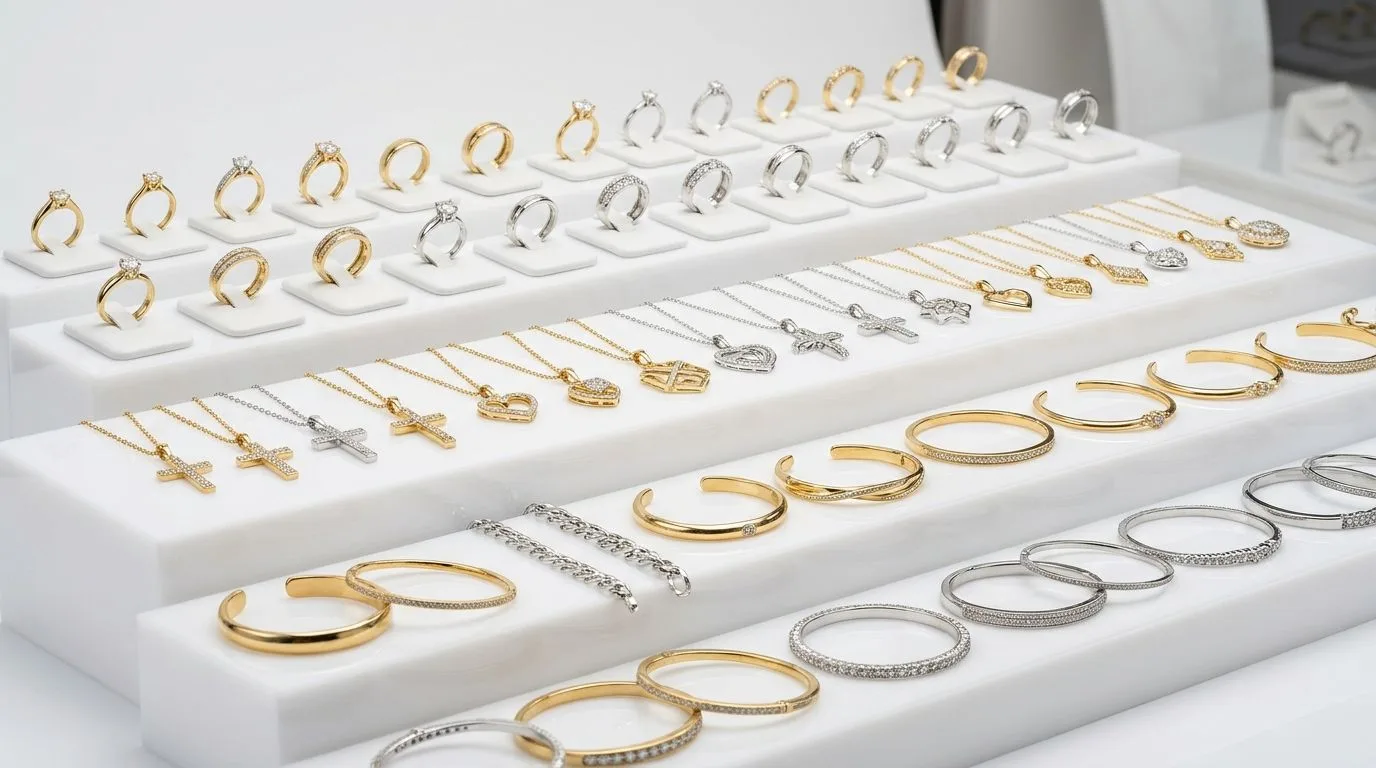
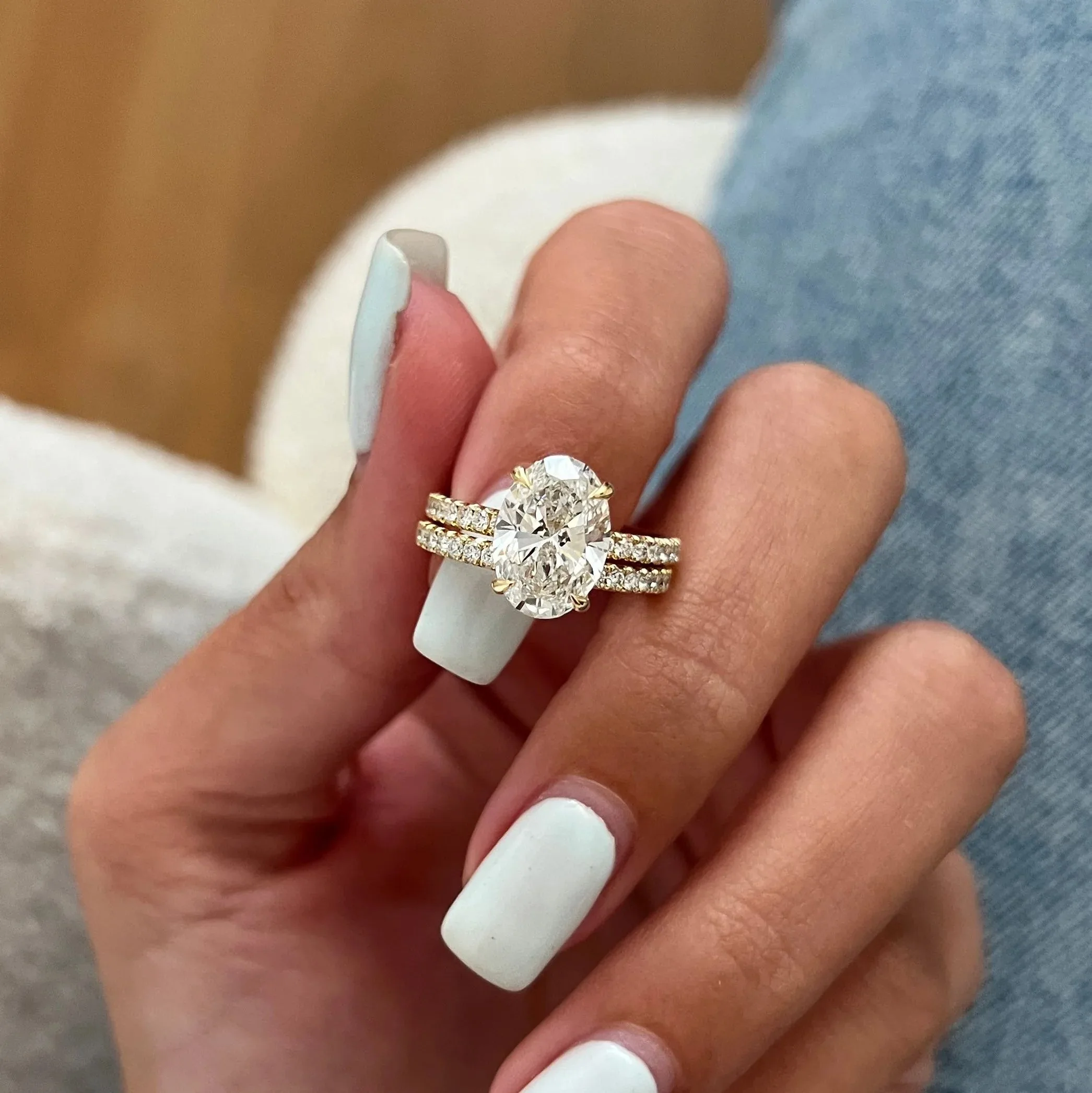

Manufacturers sit at the start of the jewelry supply chain, and they carry a photography burden that retailers rarely appreciate. A manufacturer might produce hundreds or thousands of distinct pieces, each of which needs presentation imagery for catalogs, line sheets, and buyer meetings, and the catalog is never finished because new designs are added continuously. Maintaining an in-house studio to keep up is expensive, and outsourcing every SKU to a photographer is slow. The problem is structural rather than occasional: photography is not a one-time setup cost for a manufacturer but a permanent operating burden that grows with every new design added to the range. This is precisely the problem AI jewelry photography is suited to solve.
The manufacturer's specific problem
The defining characteristics of a manufacturer's photography need are volume and consistency. Volume, because there are many pieces and more arriving all the time. Consistency, because buyers and wholesale partners judge a line as a whole, and a catalog stitched together from shoots done at different times, under different lighting, with different framing, looks amateurish even if each individual photo is competent. The manufacturer's goal is a uniform, professional catalog that keeps pace with production.
How generation fits
AI photography addresses both halves of the problem. From a single clean reference photo of each real piece, the tool generates presentation images, clean packshots and, where useful, on-model shots, to a fixed template. Because every image is generated to the same background, lighting, and framing, the catalog is uniform by construction rather than by careful art direction. And because each new design only needs a reference photo, adding to the catalog is fast enough to keep up with production instead of lagging months behind.
It is important to be precise about what this does and does not mean. The tool works from a photo of the real piece; it does not invent designs. The generated images must stay accurate to what is actually manufactured, because buyers order against them. Stone count, metal colour, and proportion have to match the physical item. Used this way, generation is a presentation layer over real products, not a fabrication of them.
On-model without a model shoot
A specific advantage for manufacturers is on-model imagery. Showing a necklace on a neck or a bridal set in context communicates scale and drape in a way a flat packshot cannot, but organising model shoots is exactly the kind of overhead manufacturers rarely have set up. On-model rendering places a piece on a model from a product photo, so a manufacturer can offer drape-and-scale imagery without the relationships, budget, or scheduling a physical model shoot would require.

Consistency across metals and materials
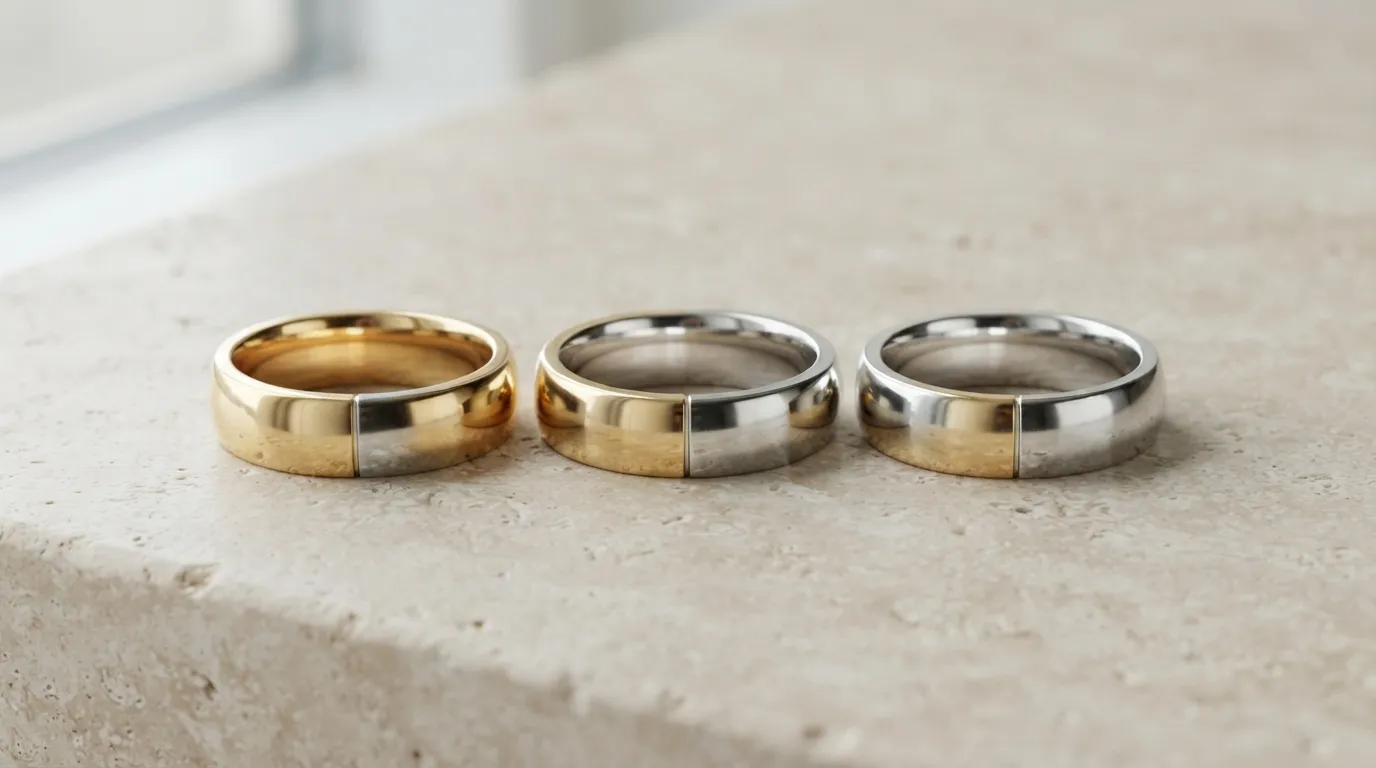
A manufacturer's catalog is rarely one material. The same line might include yellow gold, white gold, and rose gold variants of a design, sterling silver ranges, and platinum pieces, and each metal photographs differently. Yellow gold needs accurate warmth so it does not read as a lower karat; white gold and platinum need to be distinguished from each other rather than rendered as a generic grey; rose gold needs its pink tone held true; and sterling silver needs to look bright without blowing out to white. A consistent catalog template has to accommodate all of these honestly, so that a buyer comparing the gold and silver versions of the same design sees an accurate difference in metal rather than an accidental difference in photography.
This is one of the hardest things to achieve with piecemeal studio work shot over weeks, because metal rendering drifts as lighting and white balance vary between sessions. Generating every piece to a fixed specification, with the metal colour anchored to the real item, keeps a multi-metal catalog coherent. The buyer can trust that a yellow gold ring shown next to its rose gold and white gold siblings reflects the genuine difference between those metals, which is exactly the kind of accuracy a wholesale buyer needs when ordering across a full range.
Line sheets, look books, and buyer meetings
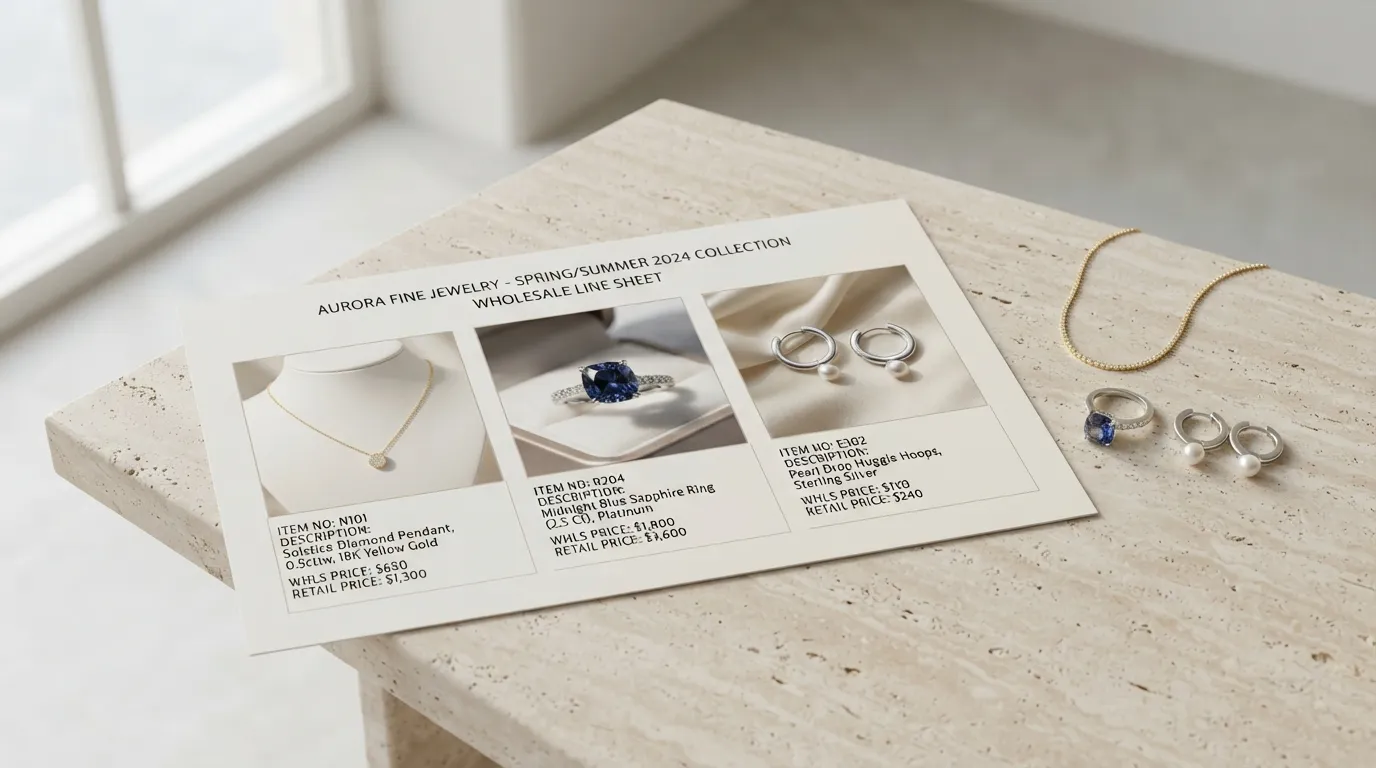
Manufacturers do not merely need marketplace packshots; they need imagery that works in the specific formats of business-to-business selling. Line sheets require clean, uniform images at a consistent size so a buyer can scan dozens of styles quickly. Look books and seasonal presentations benefit from a more styled treatment that still stays accurate to the pieces. Buyer meetings increasingly happen over screens, where image quality directly shapes the impression a manufacturer makes. Producing all of these from the same reference photos, to templates suited to each format, means a manufacturer can equip its sales effort completely without commissioning a separate shoot for every document.
The efficiency compounds across a sales season. A manufacturer launching a new collection can generate the marketplace packshots, the line sheet images, the on-model shots for the look book, and the social-ratio variants its retail partners might want, all from one capture pass over the real pieces. Instead of photography being the slow step that holds up a launch, it becomes something produced in step with the collection itself, ready the moment the pieces are finished.
Keeping inputs accurate at the source
Because manufacturers are the origin of the supply chain, the accuracy of their imagery sets the standard for everyone downstream. A reference photo that clearly shows stone count, setting detail, and true metal colour produces a generated image a buyer can order against with confidence; a poor or ambiguous reference produces an image that invites disputes. The small discipline of capturing a clean, well-lit reference of each real piece, with the metal and stones clearly visible, is therefore worth building into the production process itself, so imagery generation has accurate inputs as a matter of routine rather than a scramble after the fact.
From production line to published catalog
The deeper opportunity for manufacturers is to treat imagery as a step in production rather than a separate project that happens afterward. In the traditional model, pieces are made, then at some later point a photography effort is organised, often weeks behind production and frequently incomplete, which is why so many manufacturer catalogs lag reality and carry gaps. When a clean reference photo is captured as each piece comes off the bench, and generation turns that reference into catalog imagery on demand, the published catalog can track production almost in real time. A new yellow gold collection finished this week can have its full image set, packshots, on-model frames, line sheet images, ready for buyers this week rather than next quarter.
This closes one of the most persistent problems in jewelry manufacturing: the gap between what a manufacturer can make and what it can show. Sales teams are no longer pitching from an outdated catalog or apologising for pieces that exist but have no images; the visual catalog becomes a true, current representation of the inventory. For a manufacturer competing for the attention of retail buyers and wholesale partners, being the supplier whose catalog is always complete, consistent, and current is a real advantage, and it is achievable only when imagery production keeps pace with the workshop rather than trailing far behind it. It also reduces the friction of export and cross-border selling, where buyers who cannot visit in person rely entirely on imagery to judge a range, and a complete, accurate, consistent catalog is often the deciding factor in whether a distant buyer places an order at all.
Adding value down the chain
There is a commercial angle beyond efficiency. When a manufacturer supplies retail-ready, marketplace-compliant images alongside the pieces themselves, the buyer can list and sell faster instead of reshooting everything. That makes the manufacturer a more valuable partner, and in a crowded supply market it can be the differentiator that wins repeat orders, because a buyer who can take a manufacturer's pieces straight to market with usable imagery will favour that supplier over one who ships product with no images at all. It also shortens the buyer's own time to revenue, which is a tangible benefit a manufacturer can point to when negotiating, since every day a buyer saves on photography is a day the pieces are earning rather than waiting. Hylo's AI Photoshoot generates the consistent packshots and on-model frames a catalog needs, AI Retouch cleans existing reference shots, and batch processing keeps a large, growing catalog uniform, so manufacturers can turn photography from a bottleneck into something they offer their buyers as part of the deal.