Most jewelry photography advice is written with faceted stones in mind, and applying it to pearls and opals produces disappointing results. Diamonds, sapphires, and cut gemstones make their impact through sparkle, hard, bright points of reflected light thrown from many facets, so the instinct is to use crisp, directional light to maximise that sparkle. Pearls and opals work in the opposite way. Their beauty is soft and optical: a pearl's gradual luster across a smooth curve, an opal's shifting play-of-colour from within. Light them like diamonds and you destroy exactly what makes them desirable.
The physics of soft luster
A pearl has no facets. Its luster is the soft glow of light reflecting and refracting through the smooth nacre surface, and on camera it reads as a gentle gradient from a bright highlight, through mid-tones, into shadow across the pearl's curve. That gradient is the depth. The single most common mistake is hard light that blows the highlight to pure, flat white, which collapses the gradient into a featureless bright patch and makes the pearl look like a plastic bead. The fix is large, soft, diffused light placed at a distance, and careful exposure that protects the highlight so it keeps its tone rather than clipping. A well-photographed pearl shows a smooth transition of light, not a hot spot.
Opals and play-of-colour
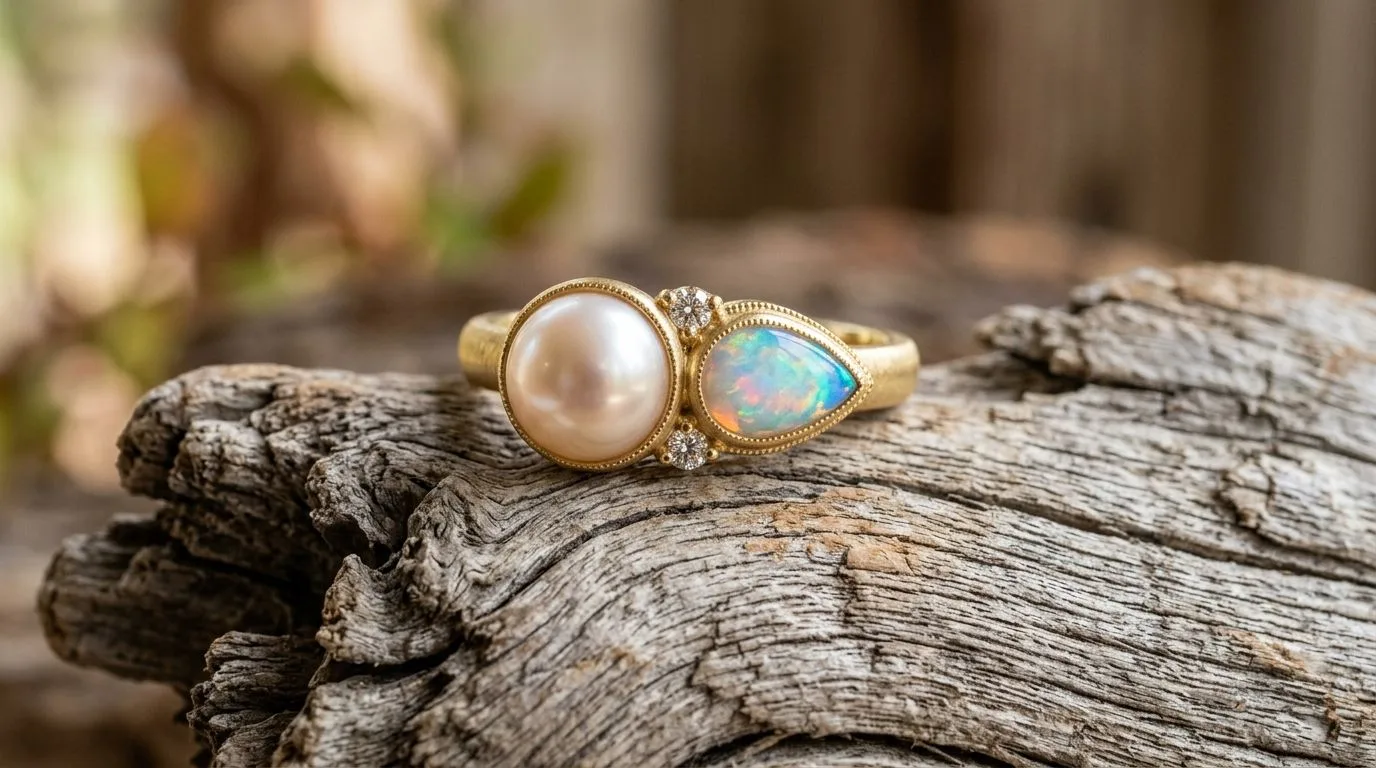
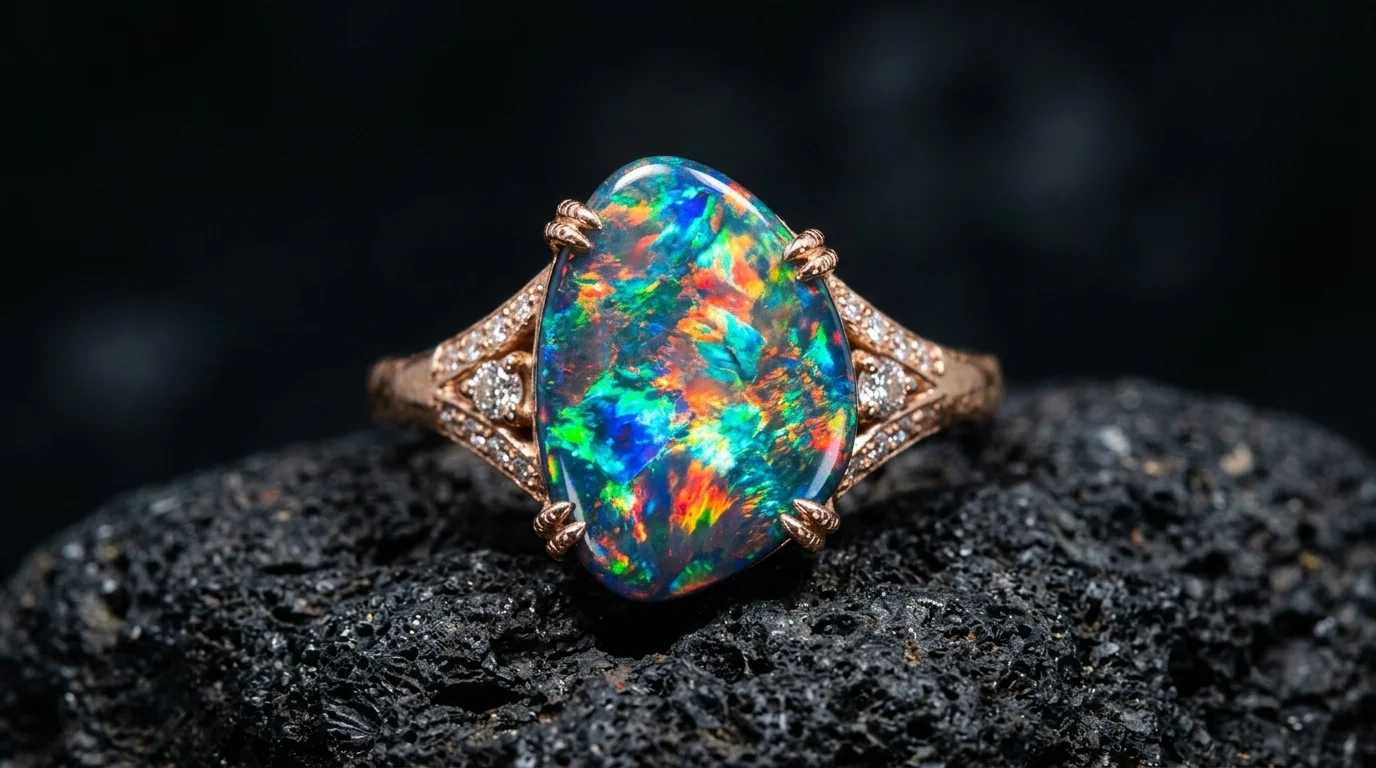
Opals add a second dimension: play-of-colour, the flashes of spectral colour that appear and shift inside the stone as the viewing or lighting angle changes. Because the effect is angle-dependent, capturing it is partly a matter of geometry. You still want soft light to avoid harsh reflections on the stone's surface, but you actively vary the angle of the light relative to the stone and camera, watching the live view, because small changes make the colour flares bloom or vanish. The goal is to find the angle where the opal's internal colour is at its most vivid in your frame, then lock it in. A flatly lit opal looks dull; a well-angled one comes alive.
Colour accuracy for smooth stones
Both materials demand the same colour discipline as gold, and for the same commercial reason. Pearls come in a range of body colours, white, cream, pink, gold, grey, black, frequently with a subtle overtone, and that colour is central to what the buyer is choosing. An opal's particular colour and pattern is similarly specific. Because these surfaces are smooth and somewhat reflective, strongly coloured surroundings can bounce into them and distort their delicate colour, so neutral backgrounds and neutral fill are important. Set white balance carefully and preserve the true body colour and overtone, because a buyer who chose a pink-overtone pearl and receives a plain white one will return it.
Understanding nacre and why luster reads the way it does
To photograph pearls well, it helps to understand what you are actually capturing. A pearl's surface is nacre, layer upon layer of translucent material, and its luster comes from light penetrating slightly into those layers and reflecting back, rather than bouncing off a hard surface the way it does on a faceted stone. This is why pearl luster is soft and has depth: you are seeing light that has interacted with the material, not a flat reflection. A high-luster pearl shows a bright, almost sharp reflection of the light source surrounded by a soft glow, while a lower-luster pearl shows a duller, more diffuse return. Buyers and graders judge pearls heavily on this luster, so your photography has to preserve it faithfully.
The practical consequence is that the shape and softness of your light source becomes part of the subject. Because you can see the light source reflected in the pearl's surface, a large soft source produces a broad, gentle highlight that flatters the luster, while a small hard source produces a tight, harsh hot spot that looks cheap and hides the depth. In effect, when you photograph a pearl you are photographing your light source reflected in it, so the quality of that source is visible in every frame. This is the opposite of faceted-stone photography, where a small bright source maximises sparkle; for pearls, big and soft wins.
Exposure: the highlight is everything
The most common pearl photography failure is overexposure of the highlight. Because a pearl's luster reads as a gradient from bright highlight through mid-tones to shadow across its curve, and because that gradient is what conveys roundness, depth, and quality, blowing the highlight to pure white destroys the very information the buyer needs. A clipped highlight has no tone, no detail, and no gradient; it is just a white patch, and a pearl with a white patch looks like a plastic bead. Once a highlight is clipped in capture, no amount of editing can recover the detail that was never recorded.
The fix is to expose for the highlight rather than the overall scene. Meter so that the brightest part of the luster sits just below clipping, retaining tone, and let the rest of the pearl fall into its natural gradient. On a histogram, you want the highlight approaching but not touching the right edge. Reviewing the highlight-clipping warning on your camera or in your editing software is the most reliable way to confirm you have protected it. This is a discipline rather than a setting: it means deliberately choosing to keep the brightest area slightly darker than instinct suggests, because a pearl with a graded highlight looks real and valuable, while one with a blown highlight looks flat and cheap.
Capturing opal play-of-colour reliably
Opal is among the hardest gemstones to photograph well because its defining feature, play-of-colour, is an interference effect that depends entirely on the geometry of light, stone, and viewer. The flashes of green, blue, orange, and red within the stone appear only at particular angles, and they shift or vanish as that geometry changes. This means there is no single "correct" exposure that captures an opal; there is a correct angle, and finding it is an interactive process. Work with the live view on, and move the light, the stone, or the camera in small increments while watching the colour bloom and fade, until the most vivid display is positioned where you want it in the frame.
Soft light still matters for opals, because a hard reflection on the polished surface competes with and obscures the internal colour, but softness alone is not enough; the angle is what unlocks the colour. It is often worth capturing several frames at slightly different angles, because an opal that looks one way in person can be surprisingly difficult to represent in a single image, and having options lets you choose the frame that best matches how the stone looks in the hand. The honesty rule applies with particular force here: the goal is to show the opal's genuine play-of-colour at its best angle, not to exaggerate colour the stone does not actually have, because an opal is bought specifically for its play-of-colour and a buyer will immediately notice if the real stone is duller than the photo.
Body colour, overtone, and accurate rendering
Pearls are not simply white. They have a body colour, white, cream, pink, silver, gold, grey, through to black, and frequently an overtone, a subtle secondary colour that plays over the body colour, such as a rosé or green overtone on a white pearl. Both the body colour and the overtone are part of what the buyer is selecting and paying for, and they are delicate enough that careless white balance or coloured reflections can shift them. A white pearl with a desirable rosé overtone can be rendered as a plain cold white by the wrong white balance, misrepresenting exactly the quality that made it special.
The colour discipline is therefore the same as for gold, and just as commercially important. Set white balance with a grey card under consistent light, shoot RAW so you can correct precisely, and keep coloured surfaces away from the piece since the smooth pearl surface reflects its surroundings. When you correct, target the pearl's true body colour and overtone as seen under neutral light, not an idealised white. For strands, there is an added challenge: the pearls should be matched and rendered consistently along the strand, so that the image shows the genuine uniformity (or character) of the actual necklace rather than introducing colour variation that is not really there.
Photographing strands, studs, and set pieces
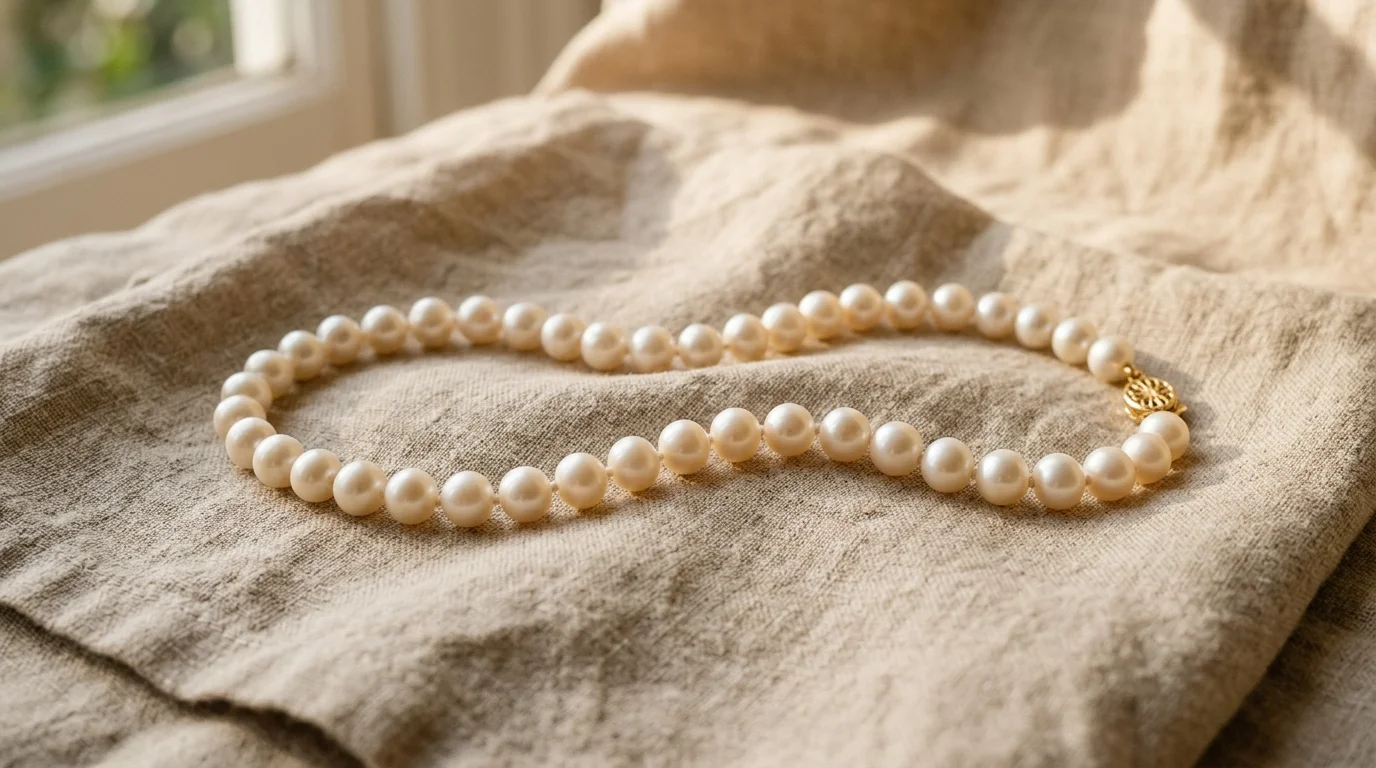
Different pearl and opal pieces raise different practical problems. A pearl strand needs even lighting along its whole length so that every pearl shows comparable luster, which is harder than lighting a single pearl because a light placed for one end may fall off toward the other. A large, broad source positioned to wrap the whole strand, or careful fill, keeps the luster consistent bead to bead, and the image should reflect the genuine matching of the actual necklace rather than introducing artificial variation. Drape matters too: a strand photographed in a natural curve shows its length and how it will hang, while a strand laid dead straight can look stiff and hide its real character.
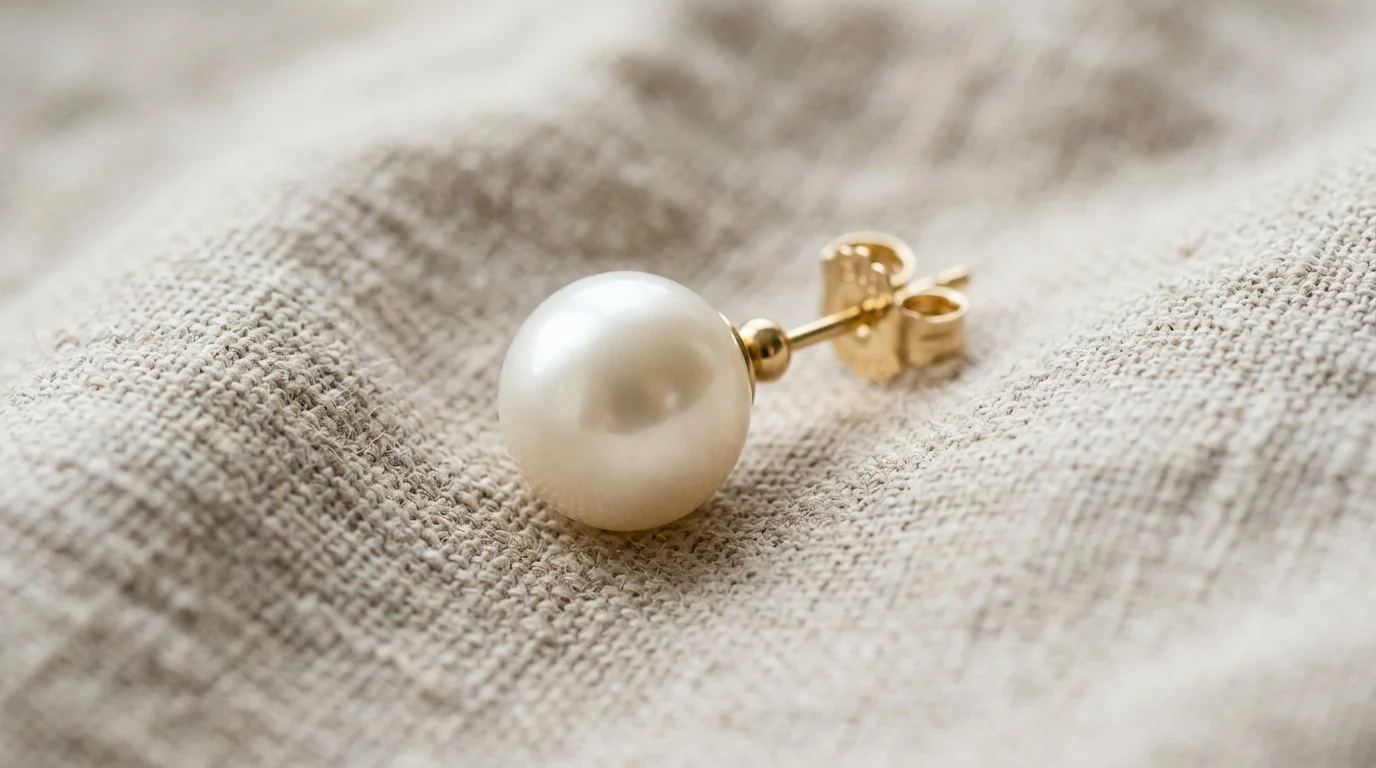
Stud and small-pearl earrings present the opposite challenge of scale, where the pearl is small in the frame and its luster can be lost if the light is not shaped to it, while opal rings and pendants need the angle-finding process described earlier to bring out play-of-colour at the size the stone actually is. Set pieces, a pearl necklace with matching earrings, should be lit and corrected as a unit so the body colour and luster match across the set, because a buyer purchasing a set expects the pieces to look like they belong together. In every case the underlying rules hold, soft wrapping light, protected highlights, accurate colour, but the framing and lighting placement adapt to the form of the piece.
Why these materials reward accuracy most
Pearls and opals are, in a sense, the ultimate test of honest jewelry photography, because their entire value lives in subtle optical qualities that are easy to fake and easy to get wrong. A faceted diamond has objective specifications, carat, cut, colour, clarity, that anchor the buyer's expectations regardless of the photo. A pearl's luster and overtone, or an opal's play-of-colour, are far more dependent on presentation, which means the temptation to enhance is strong and the consequences of enhancing dishonestly are severe. A buyer who receives a pearl with less luster or a duller overtone than the image, or an opal whose colour barely flashes compared to the photo, feels the gap immediately, because these qualities are exactly what they were buying.
This is why the accuracy discipline matters more here than almost anywhere else, and why it pays off. A seller who consistently represents pearl luster and opal colour faithfully builds trust in a category where buyers are often unsure how to judge quality and are therefore especially reliant on the seller's honesty.
Faithful imagery becomes a competitive advantage: the buyer who receives exactly what the photo promised returns to buy again and recommends the seller, while the one who feels misled does neither. For these subtle, optically defined materials, honesty is not a constraint on good photography; it is the definition of it.
It is worth adding that these materials reward patience in capture more than expensive equipment. A pearl photographed with a single large diffused source, careful exposure, and accurate white balance will look better than one shot with elaborate gear but hard light and a blown highlight, and an opal captured at the right angle on a modest setup will outshine a flatly lit one taken with the best camera. The skill that matters is observation: watching how the luster gradient falls, where the highlight clips, and at what angle the opal's colour ignites, then adjusting deliberately. That attentiveness, applied consistently across a catalog, is what separates pearl and opal imagery that sells from imagery that makes these remarkable stones look ordinary.
Backgrounds and presentation
Choose backgrounds that support rather than compete with these subtle stones. For pearls, a background that contrasts gently with the body colour lets the pearl stand out without a harsh outline. For opals, a neutral or darker background can make the play-of-colour read more vividly. The through-line with both materials is restraint: soft light, careful exposure, neutral surroundings, and accurate colour. Hylo's AI Retouch and AI Photoshoot can present and clean pearl and opal imagery, and the standard for a good result is the same as in-camera, that the luster, body colour, and play-of-colour still look like the real stone rather than an idealised stand-in. These materials are defined by their subtle optics, so faithfulness is the whole measure of quality. Master the soft light, the protected highlight, the right angle, and the accurate colour, and pearls and opals will photograph as the quietly beautiful stones they are, which is exactly what turns a curious browser into a confident buyer who trusts that what they see is what they will receive. In a category where buyers often feel uncertain about how to judge quality, that earned trust is the most valuable asset your photography can build.