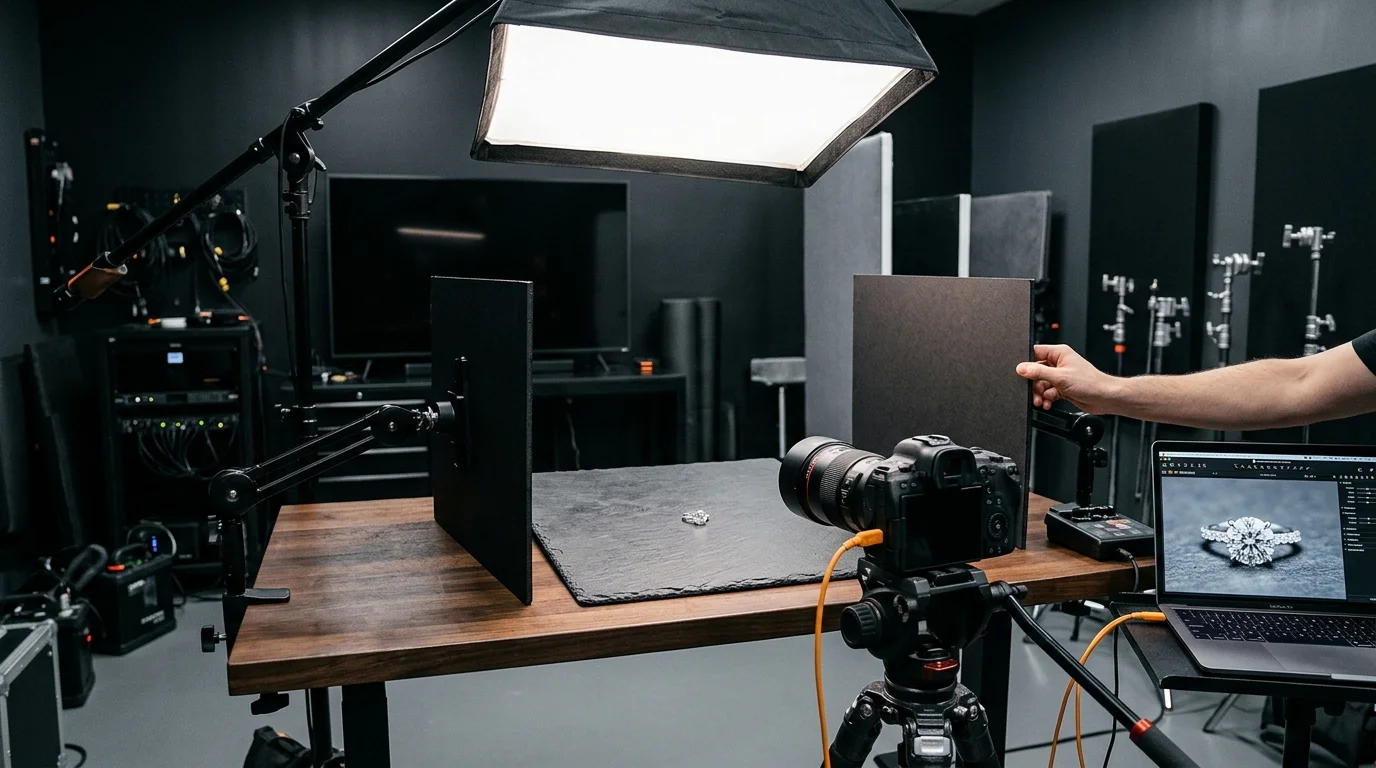
An AI product photograph often looks convincing for the first few seconds.
The image is sharp, the setting is tasteful, and the product appears professionally lit. If you saw it while scrolling quickly through a social feed, you might assume it came from a commercial studio.
Then something begins to feel wrong.
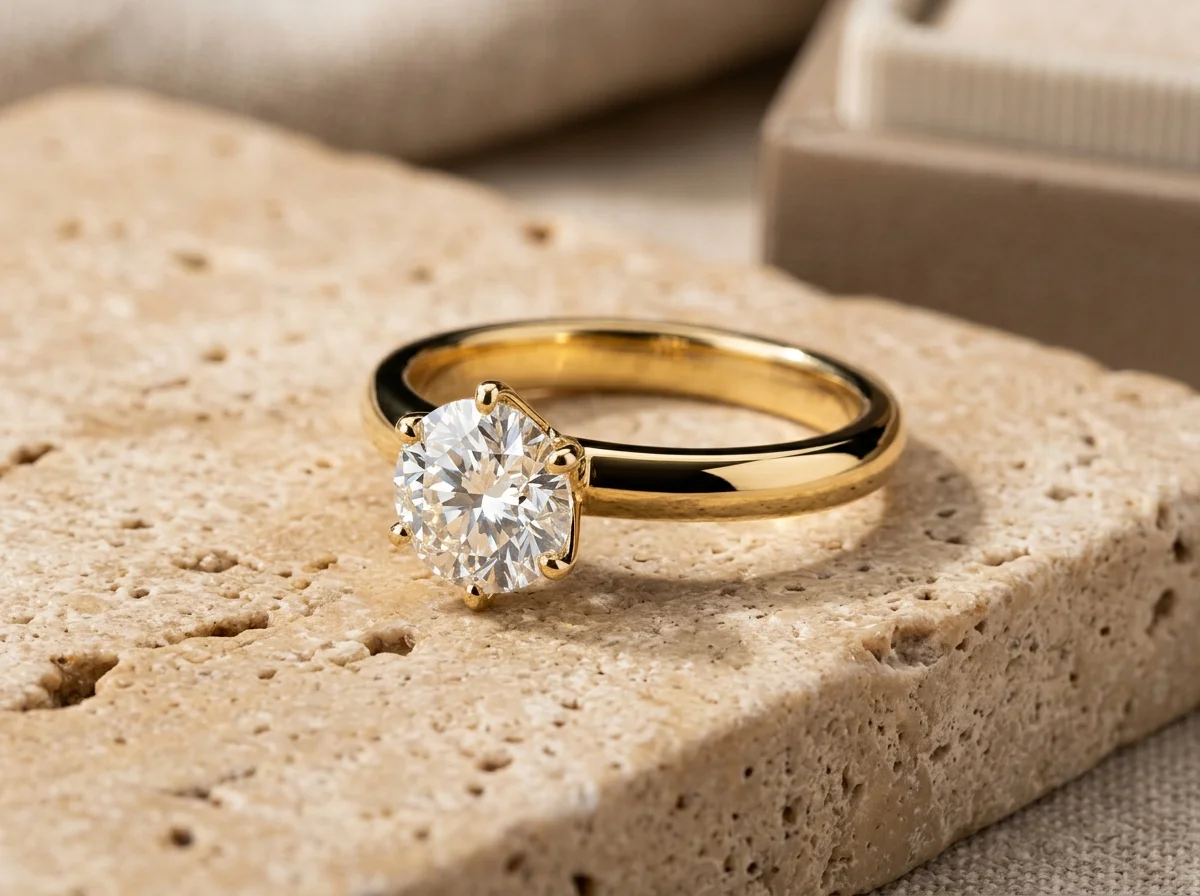
Over years of building commercial AI photography systems and analyzing thousands of generated product images across fine jewelry, luxury watches, and gemstones, one pattern appeared repeatedly: most AI images still do not look like they came from a real studio. The light falling on the product seems to come from a different room than the light falling on the table. A reflection contains bright highlights but incorrect geometry. The product touches the surface, yet its physical weight never quite arrives.
None of these errors is immediately dramatic. The product may be recognizable, and the generated background may be visually impressive. However, while every individual detail can look plausible alone, the photograph as a whole remains unconvincing.
When expanded across a commercial catalog, this problem becomes severe. One image might look beautiful in isolation. Twenty images reveal that the apparent studio keeps changing: shadows become softer, camera angles shift, 18k yellow gold changes character, and visual hierarchy drifts from one SKU to the next.
The fundamental issue is not simply that AI produces occasional artifacts. Traditional photography has imperfections too. The deeper problem is that commercial product photographs must behave like records of one coherent physical event.
Why Do AI Product Photos Look Unrealistic?
The short answer is that an image model learns how photographs tend to appear. It does not necessarily reconstruct the physical process that created them.
A conventional photograph begins with a real scene. A physical object—such as an 18k yellow gold ring with a bezel-set gemstone—has a fixed shape and material. It sits at a specific distance from a surface. Light leaves one or more sources, strikes the object, passes through transparent materials according to Snell's Law of Refraction:
Snell's Law: n₁ sin θ₁ = n₂ sin θ₂
and Fresnel Specular Reflectance:
Fresnel Reflectance: Rₛ = |(n₁ cos θᵢ - n₂ cos θₜ) / (n₁ cos θᵢ + n₂ cos θₜ)|²
bounces from polished surfaces, and reaches a lens from a specific position. The camera records the combined result.
An unconstrained image model works in the opposite direction. It produces pixels that statistically resemble the pixels found in photographs.
That distinction sounds subtle, but it explains many of the visual failures people sense before they can name them. A model can generate a plausible specular highlight along a metal shank because highlights frequently appear on metal bands in photographs. It does not follow that the model has established a light source capable of producing that highlight, the corresponding cast shadow on the table, and every related reflection elsewhere in the scene.
Appearance Is Not Physical Correctness
Consider an 18k yellow gold solitaire ring photographed on dark slate.
A plausible synthetic image might contain:
- A bright vertical reflection along the band;
- A soft shadow below the setting;
- Warm light on the front of the gemstone;
- A cool gray background;
- A narrow rim light around the upper edge.
Each feature is familiar from luxury photography. Each may look correct when inspected alone.
However, those features imply facts about the scene. The vertical reflection suggests a tall, bright diffusion panel or reflector. The soft shadow implies a large light source placed relatively close to the product. The rim light suggests another source behind it. The warm front light should influence the stone, gold, table, and nearby reflections in related ways.
If those implications disagree, the image loses physical coherence. The viewer does not need to understand studio lighting to notice. People spend their lives interpreting light as evidence about shape, distance, material, and space. We use it to decide whether a surface is wet, whether a step is deep, whether an object is near us, and whether a surface is solid 18k yellow gold or yellow plastic.
Commercial photography depends heavily on this ordinary perceptual ability. AI can satisfy many local expectations while violating the physical relationships between them.
Resolution Cannot Repair a Broken Scene
It is tempting to treat realism as a matter of detail:
- Increase the resolution from 1024px to 4K;
- Add sharper texture to background travertine;
- Render more facets in a diamond;
- Make the background less smooth;
- Preserve engraving details more clearly.
These improvements matter, but they do not solve the underlying problem. A highly detailed contradiction is still a contradiction.
If a sterling silver bracelet casts a shadow to the right while its strongest reflections imply a key light source on the right, adding more pixels only makes both conflicting signals clearer. If an emerald (refractive index n ≈ 1.57–1.58) looks transparent near its crown and opaque near its pavilion without lighting to explain it, sharper inclusions make the inconsistency more noticeable.
Realism depends less on the number of details than on whether the details agree.
Reflective Products Expose Mistakes
This is one primary reason jewelry photography is uniquely difficult.
A matte ceramic cup mostly tells us about its shape through diffuse shading. A polished platinum or 22k yellow gold ring also tells us about everything surrounding it. Its surface behaves like a compressed, curved mirror of the studio.
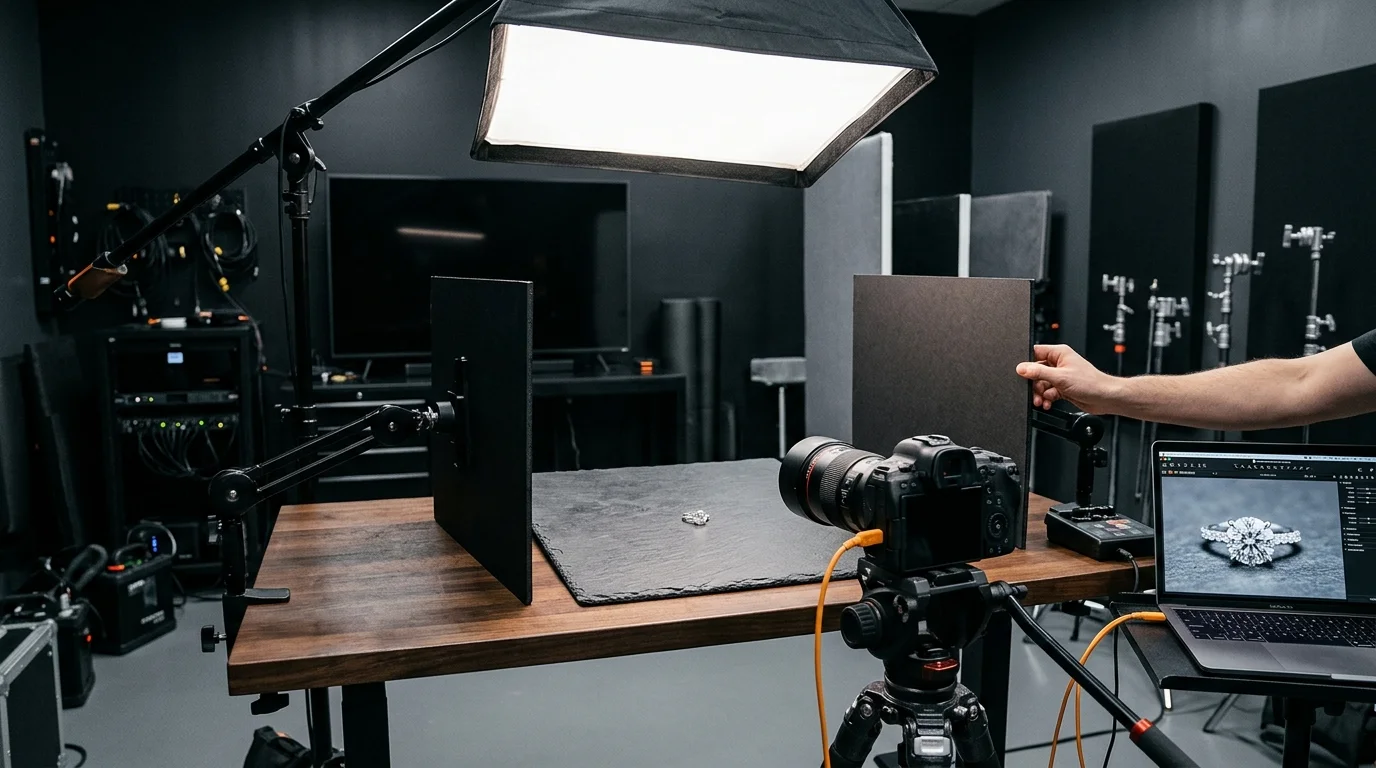
Change the ring's curvature and the reflection changes. Move a softbox and the highlight travels around the band. Place a black card near the product and it creates the dark line needed to define an otherwise bright edge.
In a real studio, photographers rarely light polished gold or silver directly. Instead, they construct an environment for the metal to reflect.
That environment must remain continuous and physically accurate across:
- The outer polished band;
- The inner shank curve;
- Micro-prongs holding stones;
- Polished gemstone facets;
- The tabletop surface;
- Nearby props;
- The product's shadow.
Generative models can reproduce the visual vocabulary of this setup without maintaining a single underlying environment. The result often resembles a collage of individually plausible reflection patterns.
Gemstones double this complexity. A faceted diamond (refractive index n ≈ 2.417) or sapphire (refractive index n ≈ 1.76) contains reflection, refraction, light absorption, internal total reflection, and partial views of its surroundings.
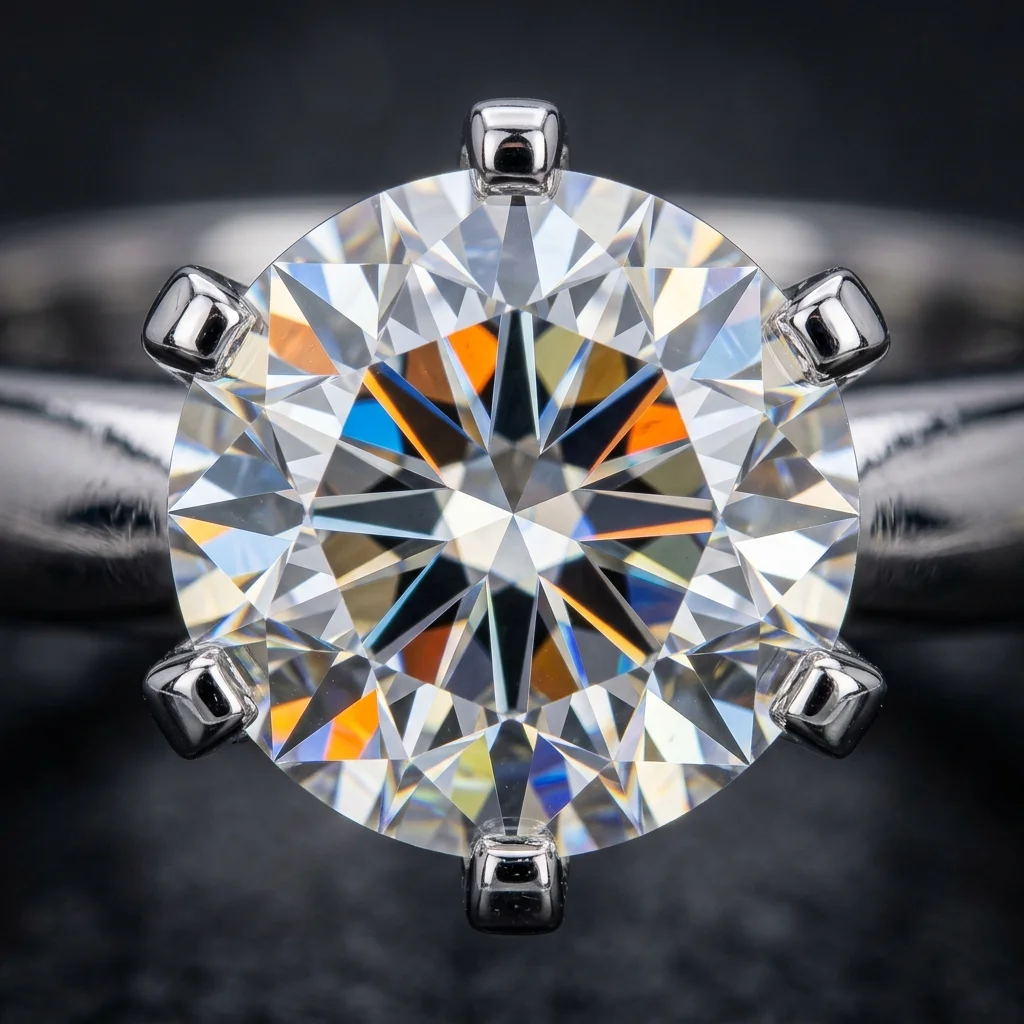
A pavé setting repeats that problem across dozens of small stones, each oriented differently. The model is not merely drawing "a diamond." It is implicitly being asked to solve a compact light-transport problem while preserving the exact commercial identity of the product.
Contact Is a Small Detail With a Large Effect
Objects in generated scenes often appear inserted rather than present.
The usual explanation is a bad shadow, but contact involves more than placing a dark patch below an object. Near the point where two surfaces meet, light becomes partially occluded. Reflected color can transfer between materials (such as warm 18k yellow gold casting an amber glow onto white marble). The object may compress fabric, overlap a texture, or create a very narrow contact shadow before the broader cast shadow begins.
These cues establish weight. A pendant resting on linen should affect the folds around it. A ring standing on travertine stone should have a precise contact point. A bottle placed on acrylic should interact with both its shadow and its mirror reflection.
When those effects are missing, the product floats. When they are exaggerated, it appears pasted down.
Why "Good Enough" Is Not Commercially Usable
An image can be aesthetically successful and commercially unsuccessful at the same time.
AI art is usually judged as an individual output. Product photography belongs to a commercial system: a product page, campaign, marketplace listing, wholesale catalog, email, or paid advertisement. Its job is to communicate the product accurately and reinforce a repeatable brand identity.
Product Photography Carries an Implicit Promise
A customer cannot handle an item on a Shopify page. The photograph stands in for touch, scale, weight, finish, and craftsmanship. That makes small visual errors commercially meaningful.
If sterling silver appears like chrome in one image and brushed aluminum in another, the customer receives conflicting information about the finish. If a bezel-set sapphire changes proportion between shots, the photographs no longer describe one product. If a chain becomes slightly thicker, a prong disappears, or an engraved edge softens, the image may be beautiful while misrepresenting what will arrive.
This matters most where material and construction justify the price. Luxury perception does not come from making everything glossy. It comes from controlled specificity. The buyer should be able to see why a platinum setting, hand-finished edge, or particular stone cut deserves attention.
Trust Is Accumulated Across Images
Catalog consistency is sometimes treated as a branding preference. It is also a trust mechanism.
Imagine a customer opening four product pages from the same collection. In one image, the camera is level with the product. In the next, it looks down at 30 degrees. One background is warm ivory, another is cool white. Shadows alternate between crisp and diffuse. Gold shifts from pale champagne to orange.
No single image necessarily looks bad. Together, they suggest that the catalog has no stable point of view. A coherent catalog gives the opposite impression. The customer may not consciously identify the repeated camera height, restrained palette, or common shadow direction. They simply experience the products as belonging to the same maker.
Deep Dive: Advanced Materials & Complex Jewelry Architectures
Commercial jewelry encompasses diverse metal alloys, stone cuts, and regional craftsmanship styles. Each material family introduces specific physical constraints that generic AI renders consistently mishandle.
1. Traditional Kundan, Polki, and Jadau Bridal Work
Indian bridal jewelry—such as Kundan necklaces, uncut Polki diamonds, and Meenakari enamel work—combines highly reflective 24k/22k yellow gold foils with flat-cut gemstones.
- The Optical Challenge: Polki diamonds lack the geometric pavilion facets of modern round brilliant cuts; they reflect light like irregular mirror sheets.
- AI Render Failure: Generic AI forces modern diamond facet reflections onto Polki stones, completely destroying the historic character of the jewelry piece.
- The Solution: Apply specialized reference identity locking that preserves flat foil reflections and hand-pressed gold foil contours.
2. Lab-Grown Diamonds vs. Natural Gemstone Inclusions
Lab-grown diamonds and natural emeralds or sapphires exhibit distinct optical behaviors under studio key lights.
- The Optical Challenge: Natural emeralds contain microscopic inclusions (jardin) that diffuse internal light, while synthetic cubic zirconia or lab diamonds display high dispersion (fire).
- AI Render Failure: AI models apply identical high-contrast sparkle to every gemstone category, making a $5,000 natural emerald look like acrylic plastic.
- The Solution: Control volumetric absorption and internal diffusion parameters within specialized post-processing tools like ai retouch in Hylo.
3. Pearl Iridescence and Nacre Depth
Pearls (Akoya, South Sea, Tahitian) do not reflect light like polished platinum or gold. Light penetrates the thin translucent nacre layers, scattering internally to produce orient (iridescence).
- The Optical Challenge: Sub-surface scattering through aragonite (CaCO₃) crystal platelets bound by conchiolin determines pearl realism.
- AI Render Failure: Standard text-to-image models render pearls as solid white spheres with a hard specular spot light, making fine pearls appear like plastic beads.
- The Solution: Require sub-surface light diffusion in your virtual studio environment setup.
Eight Principles for Commercial AI Jewelry Photography
During testing, we noticed that failed outputs often contained the requested ingredients. The right material was present. The right background was present. The requested mood was visible. Yet the photograph still did not feel commercially resolved.
The problem was usually not absence. It was relationship. A prop had the correct color but too much contrast. A shadow had the requested softness but the wrong direction. A gold surface looked polished but reflected an environment that did not appear to exist.
Useful commercial generation depends on controlling a hierarchy of decisions:
- Define the lighting system, not the lighting mood: Describe spatial sources, fill ratios, and dark edge card placements rather than vague terms like "soft luxury lighting."
- Treat composition as a constraint system: Specify product scale within frame, camera elevation, and crop tolerances.
- Establish visual hierarchy explicitly: The product must carry highest local contrast and sharpest detail. Backgrounds and props must remain subordinate.
- Manage reflections as geometry: Constrain the reflected environment. Ask if you could sketch the source or reflector that caused the highlight on the metal.
- Use negative constraints to protect commercial truth: Prohibit stone count changes, prong alterations, metal recoloring, or bezel modifications.
- Separate product preservation from scene generation: Treat reference product photos as immutable evidence rather than loose artistic inspiration.
- Encode campaigns as reusable systems: Store approved camera angles, light directions, and color palettes independently so 50+ SKUs remain consistent.
- Review relationships, not isolated details: Check whether shadows agree with highlights, reflections agree with the room, and product perspective agrees with the surface.
How Businesses Can Evaluate AI Jewelry Photography Systems
Businesses should test AI platforms with a representative production set—including polished reflective 18k yellow gold, platinum, translucent gemstones, fine chains, and similar SKUs—rather than a single easy product.
When evaluating workflows like ai photoshoot, ai retouch, or brand kit in Hylo, ensure your team checks product accuracy, scene coherence, and catalog repeatability before launching commercial campaigns.
Real photography is made of agreements. The shadow agrees with the light. The reflection agrees with the room. The product agrees with the reference image. AI jewelry photography feels like real photography when its images stop looking like a collection of plausible decisions—and begin behaving like consequences of the same physical scene.